My Clinical Approach
Adrenocortical carcinoma is one of the most challenging endocrine cancers. Outcomes are determined by two factors: complete R0 surgical resection and rigorous postoperative adjuvant management. Both require expert-centre care.
In my practice three principles guide every suspected ACC case:
- Refer early — every suspicious adrenal mass > 4-6 cm or with worrisome imaging features deserves expert-centre evaluation before surgery.
- Plan an oncological resection — open transabdominal approach with en-bloc removal of any invaded structures. Avoid laparoscopic resection in suspicious lesions.
- Coordinate adjuvant therapy from day one — mitotane plasma levels, ENSAT scoring, multidisciplinary tumour board.
What Is Adrenal Cancer?
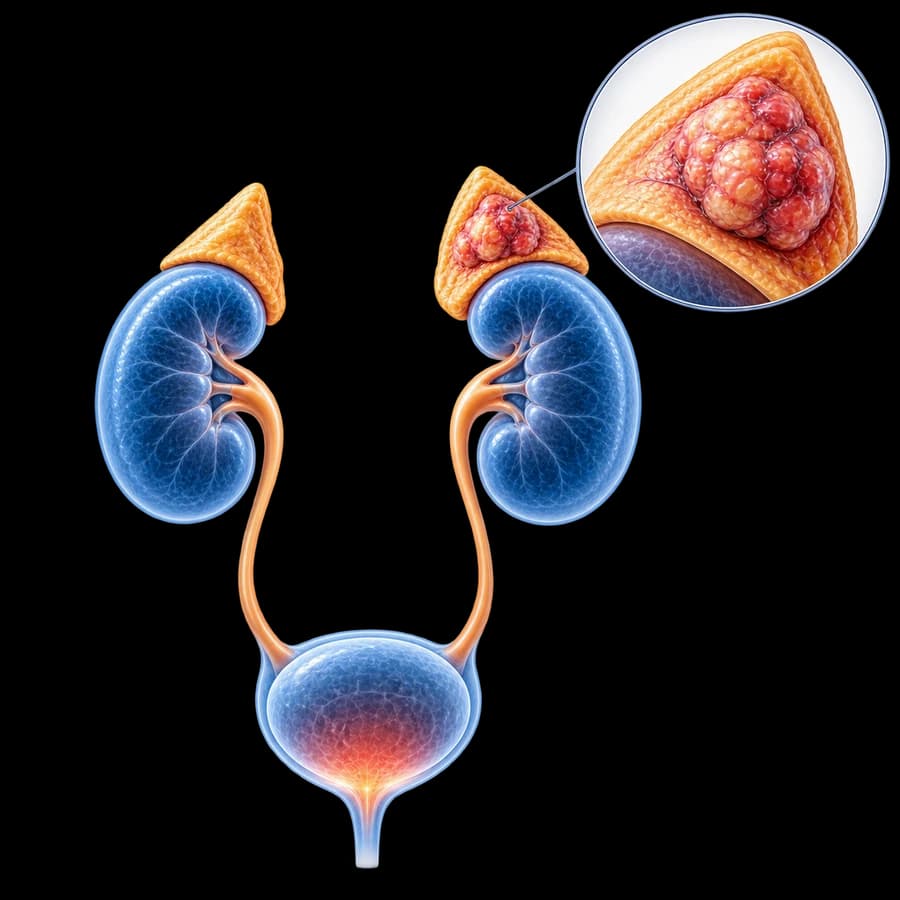
Adrenocortical carcinoma arises from the steroid-producing cortex of the adrenal gland. Annual incidence: 0.7-2 per million. Bimodal age distribution: paediatric (often associated with TP53 germline mutations — Li-Fraumeni syndrome) and adult (4th-5th decade).
Up to 60% of ACCs are functional, producing excess cortisol, androgens, or both. Pure aldosterone-secreting carcinomas are rare. Non-functional tumours often present late, as a large abdominal mass or with metastatic symptoms.
Symptoms and Hormonal Profile
- Cushingoid features — rapid-onset, often with virilisation in women.
- Virilisation in women: hirsutism, voice change, alopecia, clitoromegaly, oligomenorrhoea (DHEAS-secreting).
- Feminisation in men: gynaecomastia, testicular atrophy (rare, oestrogen-secreting).
- Mineralocorticoid excess: hypertension, hypokalemia.
- Mass effect: abdominal/flank pain, palpable mass, weight loss.
- Metastatic symptoms: bone pain, dyspnoea, hepatic dysfunction.
Key clinical clue: rapid-onset Cushing's with simultaneous androgen excess and a large adrenal mass strongly suggests ACC.
Diagnostic Workup
- Hormonal panel: 1 mg DST, 24h UFC, ACTH, DHEAS, testosterone (women), 17-OH-progesterone, oestradiol (men), aldosterone/renin, plasma metanephrines (always exclude pheochromocytoma before surgery).
- Adrenal CT with washout protocol: HU > 20 unenhanced, low absolute washout (< 60%) and relative washout (< 40%) suggest malignancy.
- Adrenal MRI with chemical shift: limited signal drop on out-of-phase suggests non-adenoma.
- CT chest/abdomen/pelvis for staging.
- FDG-PET/CT: high SUV uptake supports malignancy and detects metastases.
- Histology by Weiss score (≥ 3 of 9 criteria) ± Ki-67 (high = aggressive). Avoid pre-op biopsy except for established metastatic disease — risk of seeding.
ENSAT Staging
Stage I
Tumour ≤ 5 cm, organ-confined. 5-yr survival: ~80%.
Stage II
Tumour > 5 cm, organ-confined. 5-yr survival: ~60%.
Stage III
Local invasion (kidney, vena cava, fat) or regional lymph node involvement. 5-yr survival: ~50%.
Stage IV
Distant metastases (lung, liver, bone). 5-yr survival: < 15%.
Surgery — R0 Oncological Resection
- Open transabdominal adrenalectomy is the standard approach for tumours > 6 cm or with suspected invasion.
- En-bloc resection of any invaded structures (kidney, spleen, pancreas, liver wedge, vena cava with vascular reconstruction if needed).
- Regional lymphadenectomy for staging accuracy.
- Laparoscopic resection only in highly selected small ENSAT I tumours, with no preoperative invasion features, in expert hands.
- Capsular rupture or tumour spillage worsens prognosis dramatically — must be avoided.
- Steroid replacement perioperatively for cortisol-secreting tumours.
Adjuvant and Systemic Therapy
Adjuvant Mitotane
Recommended for high-risk disease: ENSAT III, R1/Rx resection, Ki-67 > 10%. Target plasma levels 14-20 mg/L. Duration ≥ 2 years. Patients require lifelong glucocorticoid replacement during treatment due to drug-induced adrenal insufficiency.
Adjuvant Radiotherapy
Considered after R1/Rx resection or large tumours with high local recurrence risk.
Advanced/Metastatic Disease — EDP-M
First-line: EDP-M (etoposide + doxorubicin + cisplatin + mitotane), per the FIRM-ACT trial (NEJM 2012, Fassnacht et al.). Response rates ~25%, significant survival benefit over streptozotocin + mitotane. Second-line: clinical trials, gemcitabine + capecitabine, immunotherapy in selected molecular profiles.
Follow-up and Surveillance
Per the 2018 ESE-ENSAT guideline:
- CT chest/abdomen/pelvis every 3 months for the first 2 years, then every 4-6 months years 3-5.
- Tumour marker monitoring (steroid panel) for functional tumours.
- Mitotane plasma levels every 2-4 weeks until therapeutic, then every 1-2 months.
- Long-term follow-up minimum 10 years given late recurrence risk.
- Multidisciplinary tumour board for every recurrence or treatment change.
Why a Reference Centre
ACC is rare and complex. International registries demonstrate clearly better survival in high-volume centres with dedicated multidisciplinary teams. The 2018 ESE-ENSAT guideline (Fassnacht et al.) explicitly recommends referral of every suspected ACC to expert centres before any surgical intervention.
Bottom line: Suspected ACC is an emergency for the right diagnostic and surgical pathway — not just for the operation itself. Early referral to a reference centre is the single most important determinant of long-term survival.
Frequently Asked Questions (FAQ)
What is adrenocortical carcinoma (ACC)?
Adrenocortical carcinoma is a rare aggressive malignancy of the adrenal cortex. Annual incidence: 0.7-2 cases per million. Bimodal distribution: childhood (with TP53 mutations) and adulthood (4th-5th decade). Often functional, producing cortisol, androgens, or both.
How does it differ from a benign adenoma?
Suspicious imaging features: size > 4-6 cm, irregular margins, unenhanced HU > 20, slow contrast washout, calcification, necrosis, or local invasion. Histology uses the Weiss score (≥ 3 of 9 criteria suggests carcinoma). Functional, rapid hormonal status with virilisation should also raise suspicion.
How is it staged?
The ENSAT staging system (2008) is the international standard: Stage I — tumour ≤ 5 cm, organ-confined; Stage II — > 5 cm, organ-confined; Stage III — local invasion or regional lymph nodes; Stage IV — distant metastases. 5-year survival: I ~80%, II ~60%, III ~50%, IV < 15%.
What is the standard treatment?
Complete oncological R0 surgical resection in expert centres. Open transabdominal approach is standard for large or invasive tumours; laparoscopic only in highly selected small ENSAT I cases without invasion. Adjuvant mitotane and/or radiotherapy in high-risk cases.
What is mitotane?
Mitotane (o,p'-DDD) is the only adrenocortical-specific cytotoxic agent. Used adjuvantly post-resection in high-risk disease and as the cornerstone of advanced/metastatic ACC therapy. Therapeutic plasma window 14-20 mg/L. Significant toxicity (gastrointestinal, neurological, adrenal insufficiency) requires close monitoring.
What about chemotherapy in metastatic disease?
Standard regimen: EDP-M (etoposide, doxorubicin, cisplatin + mitotane) — established as first-line by the FIRM-ACT trial (NEJM 2012, Fassnacht et al.). Response rates ~25%, with significant survival benefit over streptozotocin + mitotane.
What is the prognosis?
Strongly dependent on stage and R0 resection. Localised ENSAT I-II 5-year survival: 50-80%. Locally advanced (III): ~50%. Metastatic (IV): < 15% at 5 years. Younger age, low Ki-67, complete resection, and access to expert centres improve outcomes.
Why does centralisation matter?
ACC is rare and complex. Outcomes are demonstrably better in high-volume reference centres with multidisciplinary tumour boards (endocrinology, surgical oncology, medical oncology, radiation oncology, pathology). Per the 2018 ESE-ENSAT guideline, all suspected ACC should be referred to expert centres.
Related Topics
Book Your Appointment in Rhodes
A suspected adrenal carcinoma demands expert evaluation and a multidisciplinary plan from day one. We coordinate the full pathway with reference centres for the best possible outcome.
References
- Fassnacht M, et al. European Society of Endocrinology Clinical Practice Guidelines on the management of adrenocortical carcinoma in adults, in collaboration with ENSAT (2018) — academic.oup.com
- Fassnacht M, et al. Combination chemotherapy in advanced adrenocortical carcinoma (FIRM-ACT trial) — N Engl J Med 2012 — nejm.org
- Fassnacht M, et al. ESE/ENSAT Adrenal Incidentaloma Guidelines (2023) — academic.oup.com
Medical Review

Dr. Marinos Vasilas, Urologist — Andrologist
Dr. Marinos Vasilas works in close collaboration with national reference centres for the assessment and surgical care of adrenocortical carcinoma, ensuring that every patient benefits from a complete multidisciplinary plan.
View full bio


