My Clinical Approach
Cushing's syndrome is one of the most challenging conditions in endocrine surgery. The clinical picture can be subtle, the workup demands rigour, and the perioperative management of the cortisol axis can make the difference between a smooth recovery and a life-threatening adrenal crisis.
In my practice, three principles guide every Cushing case:
- Always confirm biochemically before pursuing imaging — incidental adrenal or pituitary findings without biochemical Cushing should not drive surgery.
- Localise correctly — high-dose dexamethasone testing, CRH stimulation and BIPSS are essential when ACTH is detectable.
- Plan perioperative steroid cover meticulously. Adrenal crisis after curative surgery is preventable.
What Is Cushing's Syndrome?
Cushing's syndrome refers to the constellation of clinical and metabolic features arising from chronic exposure to excess glucocorticoids — endogenous or exogenous. Cushing's disease specifically denotes the subset caused by an ACTH-secreting pituitary adenoma.
Untreated, Cushing's syndrome is associated with significant morbidity (cardiovascular disease, diabetes, infections, osteoporosis, psychiatric disease) and a 4–5 fold increase in mortality.
Causes and Classification
Exogenous (iatrogenic)
This is the most common cause overall, resulting from long-term steroid therapy for autoimmune, allergic, or transplant conditions.
Cushing's disease (~70% of endogenous)
This is caused by an ACTH-secreting pituitary microadenoma, and it is twice as common in women.
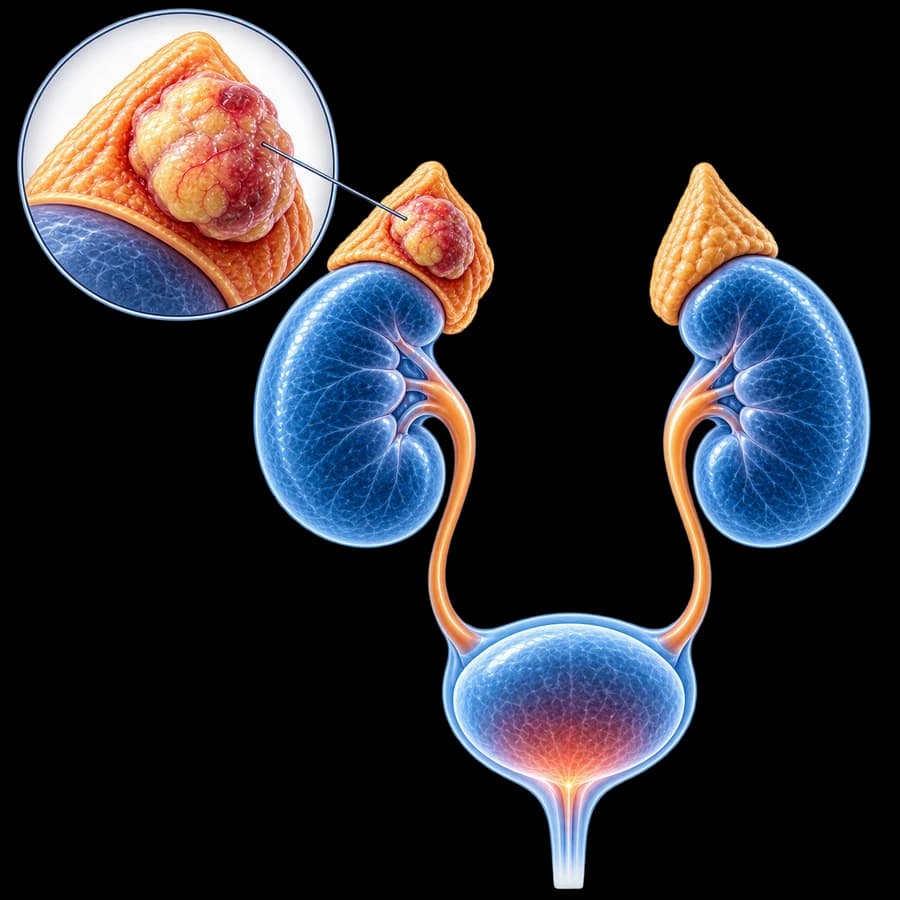
Adrenal Cushing (~15-20%)
This is caused by a cortisol-secreting adrenal adenoma or carcinoma, with macronodular or micronodular hyperplasia being rarer causes.
Ectopic ACTH (~10%)
This is caused by small cell lung cancer, bronchial carcinoid, medullary thyroid cancer, or pheochromocytoma, and it typically shows rapid clinical evolution and severe hypokalemia.
Symptoms
- Central obesity, moon face, buffalo hump, supraclavicular fat pads.
- Purple striae > 1 cm, easy bruising, thin skin.
- Proximal muscle weakness, difficulty rising from a chair.
- Hypertension, type 2 diabetes, dyslipidaemia.
- Osteoporosis with fragility fractures.
- Mood disorders, depression, cognitive impairment, psychosis.
- In women: hirsutism, menstrual irregularity, acne.
- In children: growth arrest combined with weight gain.
- Recurrent infections, poor wound healing.
Features Suggesting Severe / Ectopic Cushing
- Rapid clinical evolution (weeks to months).
- Profound hypokalemia and metabolic alkalosis.
- Severe hypertension and oedema.
- Marked hyperpigmentation.
- Diabetes with high insulin requirements.
- Severe muscle weakness without classical body habitus.
Diagnostic Workup
Per the 2008 Endocrine Society guideline, at least two of three first-line tests must be abnormal:
24h Urine Free Cortisol (UFC)
This requires two collections, and values more than 3-4 times the upper limit are highly suggestive.
Late-Night Salivary Cortisol
This requires two samples on different days and detects a disrupted circadian rhythm with high evening cortisol.
1 mg Overnight Dexamethasone Suppression Test
A cortisol level above 1.8 μg/dL at 8 a.m., after taking 1 mg of dexamethasone at 11 p.m., is positive.
Plasma ACTH (after confirmation)
ACTH below 5 pg/mL indicates ACTH-independent (adrenal) disease, while ACTH above 20 pg/mL indicates ACTH-dependent (pituitary or ectopic) disease.
Source Localisation
ACTH-Independent (Adrenal)
An adrenal CT or MRI identifies the affected gland, whether an adenoma, carcinoma, or macronodular hyperplasia, based on its imaging features.
ACTH-Dependent
A pituitary MRI identifies a microadenoma in about 70% of Cushing's disease cases. A CRH stimulation test or high-dose DST helps differentiate the source, and BIPSS is used when the MRI is equivocal: a ratio of central to peripheral ACTH above 3 at baseline, or above 2 after CRH, confirms a pituitary source.
Ectopic ACTH
A CT of the chest and abdomen is used, along with 68Ga-DOTATATE PET/CT for neuroendocrine tumours or FDG-PET for aggressive tumours.
Treatment
- Cushing's disease: transsphenoidal pituitary surgery is first-line (Pituitary Society 2021 consensus, Fleseriu et al.). Cure rates 70-85% in expert hands.
- Adrenal Cushing: laparoscopic adrenalectomy of the affected gland.
- Ectopic ACTH: surgical resection of source tumour where possible.
- Medical therapy: ketoconazole, metyrapone, osilodrostat (steroidogenesis inhibitors); pasireotide (Cushing's disease); mifepristone (Cushing's with diabetes).
- Bilateral adrenalectomy: last resort for refractory disease — risk of Nelson syndrome.
- Pituitary radiotherapy: residual or recurrent Cushing's disease.
Post-operative Management
After successful removal of the cortisol source, the patient develops secondary adrenal insufficiency due to chronic suppression of the contralateral adrenal or HPA axis. Hydrocortisone replacement is essential and continues until the axis recovers — often months to 1-2 years. Patient education on sick-day rules and steroid emergency cards is mandatory.
MACS — Mild Autonomous Cortisol Secretion
MACS describes biochemical evidence of cortisol excess (post-DST cortisol > 1.8 μg/dL) without overt Cushing's. Per the 2023 ESE/ENSAT guideline, MACS is associated with increased cardiovascular events, type 2 diabetes, hypertension, osteoporosis and mortality. Surgery is considered in younger patients with significant cortisol-related comorbidities.
Bottom line: Cushing's syndrome demands a structured, multidisciplinary approach — endocrinology, urology, neurosurgery, oncology and interventional radiology working together for diagnosis, treatment and long-term follow-up.
Frequently Asked Questions (FAQ)
What is Cushing's syndrome?
Cushing's syndrome is the clinical state caused by chronic exposure to excess glucocorticoids (cortisol). It can be due to exogenous steroids, ACTH-producing pituitary or ectopic tumours (ACTH-dependent), or autonomous adrenal tumours/hyperplasia (ACTH-independent).
What is the most common cause?
In clinical practice, the most common cause overall is exogenous glucocorticoid use (iatrogenic). Among endogenous causes, Cushing's disease (pituitary ACTH-secreting adenoma) accounts for ~70%, followed by adrenal adenoma/carcinoma (~15-20%) and ectopic ACTH (~10%).
What are the symptoms?
Central obesity, moon face, buffalo hump, purple striae, easy bruising, proximal muscle weakness, hypertension, type 2 diabetes, osteoporosis, depression and cognitive changes. In women: hirsutism, menstrual irregularity. In children: growth arrest with weight gain.
How is it diagnosed?
Per the 2008 Endocrine Society guideline: at least two of three first-line tests positive — 24h urine free cortisol, late-night salivary cortisol, or 1 mg overnight dexamethasone suppression test. Once confirmed, ACTH measurement determines ACTH-dependent vs independent.
What is MACS?
Mild autonomous cortisol secretion — biochemical evidence of mild cortisol excess (post-DST cortisol > 1.8 μg/dL) without overt Cushing's syndrome. It carries increased cardiovascular risk, diabetes, osteoporosis and mortality. Surgery is considered in selected cases.
What is the treatment?
Cushing's disease: transsphenoidal pituitary surgery first-line (Pituitary Society 2021 consensus). Adrenal Cushing's: laparoscopic adrenalectomy of the affected gland. Ectopic ACTH: tumour-directed treatment. Medical therapy (ketoconazole, metyrapone, osilodrostat, mifepristone, pasireotide) is used adjunctively or for unresectable cases.
What is BIPSS?
Bilateral inferior petrosal sinus sampling. The gold-standard test to differentiate Cushing's disease from ectopic ACTH when MRI of the pituitary is equivocal. Performed in expert centres.
What about post-surgery management?
After successful surgery, the patient develops temporary adrenal insufficiency (suppressed contralateral or pituitary axis). Lifelong or long-term hydrocortisone replacement is needed until the HPA axis recovers — sometimes months to years. Patient education on sick day rules is essential.
Related Topics
Book Your Appointment in Rhodes
A diagnosis of Cushing's syndrome — or even MACS — deserves a complete assessment in collaboration with endocrinology and (when needed) neurosurgery. We coordinate your full pathway from workup through surgery and follow-up.
References
- Nieman LK, et al. The Diagnosis of Cushing's Syndrome: An Endocrine Society Clinical Practice Guideline (2008) — academic.oup.com
- Nieman LK, et al. Treatment of Cushing's Syndrome: An Endocrine Society Clinical Practice Guideline (2015) — academic.oup.com
- Fleseriu M, et al. Consensus on diagnosis and management of Cushing's disease — Pituitary Society (2021) — thelancet.com
- Fassnacht M, et al. ESE/ENSAT Adrenal Incidentaloma Guidelines (2023) — academic.oup.com
Medical Review

Dr. Marinos Vasilas, Urologist — Andrologist
Dr. Marinos Vasilas leads the urological surgical care of patients with adrenal Cushing's syndrome and MACS, working closely with endocrinology, pituitary neurosurgery and intensive care to ensure safe perioperative steroid management.
View full bio


