My Clinical Approach
Conn's syndrome is one of the most underdiagnosed but most curable forms of hypertension. Many patients carry resistant hypertension for years before anyone thinks of testing the aldosterone-to-renin ratio — yet a single screening test can change the entire clinical trajectory.
In my practice I follow three principles aligned with the Endocrine Society 2016 guideline:
- Screen broadly — every patient with resistant hypertension, hypokalemia or an adrenal incidentaloma deserves an ARR.
- Confirm before localising — a positive ARR alone does not mean PA. Suppression testing prevents unnecessary procedures.
- Insist on AVS for surgical candidates — adrenal CT alone misclassifies up to 38% of patients.
What Is Conn's Syndrome?
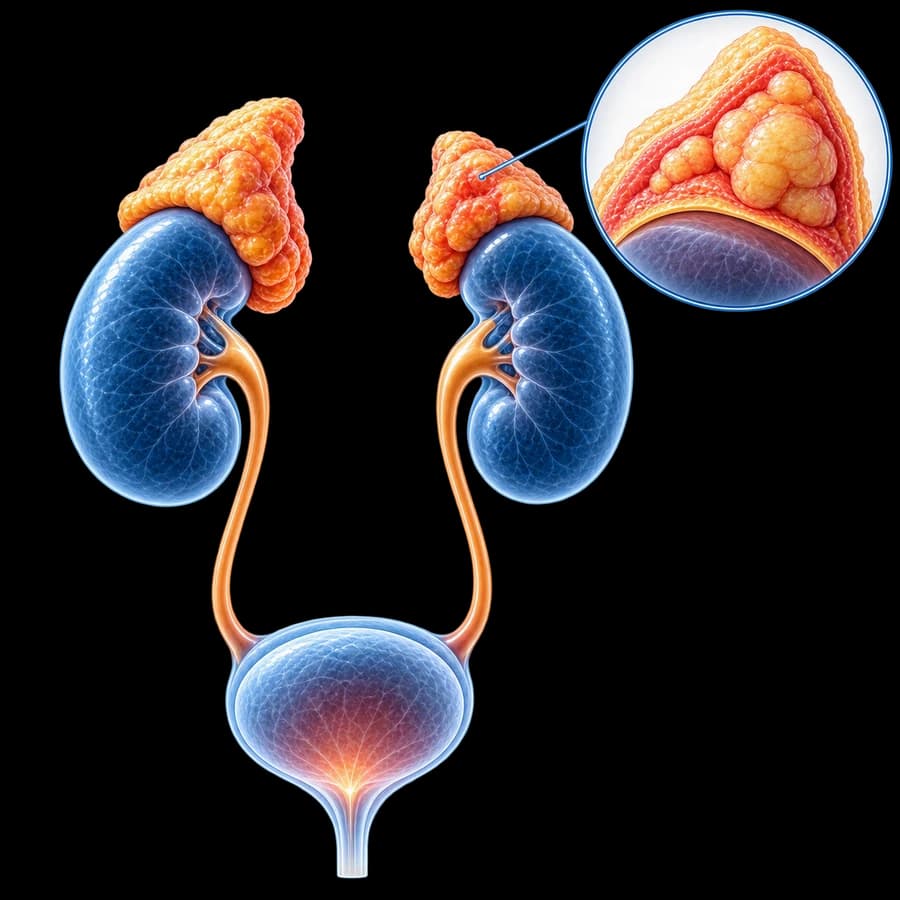
First described by Jerome Conn in 1955, primary aldosteronism is caused by autonomous overproduction of aldosterone independent of renin. The two main subtypes are:
Unilateral APA (~30-40%)
Aldosterone-producing adenoma — single adrenal tumour. Surgically curable.
Bilateral IHA (~60-70%)
Idiopathic hyperaldosteronism — bilateral adrenal hyperplasia. Treated medically.
Familial PA (rare)
Type I (glucocorticoid-remediable), Type II, III, IV — inherited forms.
Adrenal carcinoma (rare)
Aldosterone-producing carcinoma — rare but important to exclude.
Epidemiology and Cardiovascular Risk
PA prevalence: ~5–10% of all hypertensives, ~20% of resistant hypertensives. Recent population-based studies suggest the true prevalence may be even higher, with PA representing the most common identifiable cause of hypertension.
Critically, untreated PA causes more cardiovascular damage than essential hypertension at the same blood pressure levels. Patients have higher rates of stroke, atrial fibrillation, heart failure, myocardial infarction, chronic kidney disease and metabolic syndrome — independent of BP control.
Symptoms and When to Suspect PA
PA is often asymptomatic apart from hypertension. When present, symptoms reflect hypokalemia and volume overload:
- Resistant hypertension (≥ 3 antihypertensives).
- Spontaneous or diuretic-induced hypokalemia.
- Muscle weakness, cramps, paraesthesias.
- Polyuria, nocturia, polydipsia.
- Fatigue, headaches, palpitations.
- Cardiac arrhythmias (atrial fibrillation, ventricular ectopy).
Important: Up to 50% of patients with PA have normal serum potassium at diagnosis. Normokalemia does not exclude PA.
Screening: Aldosterone-to-Renin Ratio (ARR)
The ARR is the screening test of choice. Performed in the morning, after the patient has been ambulatory for at least 2 hours and seated for 5–15 minutes. Hypokalemia must be corrected first.
- Stop spironolactone, eplerenone, amiloride, triamterene, high-dose diuretics for at least 4 weeks before testing.
- Other antihypertensives (beta-blockers, ACE inhibitors, ARBs, calcium channel blockers) can usually be continued, with interpretation adjusted.
- If interpretation is critical: switch to verapamil SR, hydralazine, or alpha-blockers temporarily.
Cut-offs vary by laboratory but a commonly used threshold is ARR > 30 (when aldosterone in ng/dL and renin activity in ng/mL/h) with an absolute aldosterone > 15 ng/dL.
Confirmation Testing
A positive ARR must be confirmed before subtyping or surgery. Four options:
Saline Infusion Test
2 L of 0.9% saline IV over 4 hours. Aldosterone > 10 ng/dL post-infusion confirms PA.
Oral Sodium Loading
6 g/day NaCl for 3 days; 24h urine aldosterone > 12 μg/24h confirms PA.
Fludrocortisone Suppression
0.1 mg q6h × 4 days with sodium supplementation. Highly accurate but inpatient.
Captopril Challenge
25–50 mg captopril; aldosterone fails to suppress > 30%. Easier in outpatients.
Subtyping: CT and AVS
After biochemical confirmation, all surgical candidates need subtyping:
Adrenal CT
First-line imaging. Identifies adenomas, hyperplasia, or large suspicious lesions. However, CT alone misclassifies up to 38% of patients (Young et al., Surgery 2004).
Adrenal Venous Sampling (AVS)
Gold standard for lateralisation. Performed in expert centres. Cortisol-corrected aldosterone ratios from each adrenal vein vs IVC determine unilateral vs bilateral disease. Mandatory for surgical decision-making per Endocrine Society guidelines.
AVS may be omitted in patients < 35 years with hypokalemia, marked aldosterone excess, and clear unilateral adenoma on CT.
Treatment
Unilateral disease — Laparoscopic Adrenalectomy
Surgical removal of the affected gland is curative for biochemical PA in > 90% and produces complete BP normalisation in ~37% of cases (PASO criteria). Hypokalemia resolves in nearly all. Performed laparoscopically with minimal morbidity.
Bilateral disease — Mineralocorticoid Receptor Antagonists
First-line: spironolactone 12.5–50 mg/day (titrated). Second-line (if side effects, especially gynaecomastia): eplerenone 25–100 mg/day. Lifelong therapy with potassium and creatinine monitoring.
Outcomes and Follow-up
After surgery: aldosterone, renin and potassium at 1–3 months; assessment of cure per PASO criteria at 6–12 months; long-term monitoring of BP and CV risk factors. Many patients still benefit from continued antihypertensive support due to vascular remodelling from longstanding hypertension.
Bottom line: Conn's syndrome is common, underdiagnosed, and frequently curable. A simple ARR can change a lifetime of cardiovascular risk.
Frequently Asked Questions (FAQ)
What is Conn's syndrome?
Conn's syndrome (primary aldosteronism, PA) is the most common form of secondary hypertension. It is caused by autonomous overproduction of aldosterone by the adrenal cortex, resulting in sodium retention, hypertension, and frequently hypokalemia.
How common is it?
PA accounts for 5–10% of all hypertensive patients and up to 20% of those with resistant hypertension. It is significantly underdiagnosed worldwide, despite causing greater cardiovascular and renal damage than essential hypertension at comparable BP levels (PASO study, Williams et al., 2017).
Who should be screened?
Per the 2016 Endocrine Society guideline, screening is recommended for: resistant hypertension (≥ 3 drugs), hypertension with hypokalemia, hypertension with adrenal incidentaloma, hypertension before age 40, hypertension with family history of early stroke, and any hypertensive first-degree relative of a PA patient.
Which tests are used for diagnosis?
Initial screening: aldosterone-to-renin ratio (ARR). Confirmation in positive cases: saline infusion test, fludrocortisone suppression test, oral sodium load, or captopril challenge. Once confirmed, subtype classification with adrenal CT and adrenal venous sampling (AVS).
What is adrenal venous sampling (AVS)?
AVS is the gold standard for distinguishing unilateral (aldosterone-producing adenoma — APA) from bilateral disease (idiopathic hyperaldosteronism — IHA). Cortisol-corrected aldosterone ratios from each adrenal vein vs the IVC determine lateralisation. Performed in expert centres.
What is the treatment?
For unilateral disease: laparoscopic adrenalectomy — frequently curative for hypertension and hypokalemia. For bilateral disease: lifelong mineralocorticoid receptor antagonists (spironolactone or eplerenone). All patients also need optimal cardiovascular risk management.
Will my blood pressure return to normal after surgery?
Hypokalemia normalises in nearly 100% of cases. Complete BP cure occurs in ~37% of patients (PASO criteria); biochemical cure in > 90%. Younger age, shorter hypertension duration, female sex, and lower BMI are predictors of complete clinical success.
What about untreated PA?
Untreated PA significantly increases the risk of stroke, atrial fibrillation, heart failure, myocardial infarction and chronic kidney disease — independently of BP level. Targeted treatment reverses much of this excess risk, making early diagnosis essential.
Related Topics
Book Your Appointment in Rhodes
Resistant or early-onset hypertension deserves screening for Conn's syndrome. We work closely with endocrinology and interventional radiology to deliver a complete diagnostic and surgical pathway.
References
- Funder JW, et al. The Management of Primary Aldosteronism: Case Detection, Diagnosis, and Treatment — An Endocrine Society Clinical Practice Guideline (2016) — academic.oup.com
- Williams TA, et al. Outcomes after adrenalectomy for unilateral primary aldosteronism: an international consensus on outcome measures and analysis of remission rates in an international cohort (PASO study) — Lancet Diabetes Endocrinol 2017 — pubmed.ncbi.nlm.nih.gov
- Fassnacht M, et al. ESE/ENSAT clinical practice guidelines on the management of adrenal incidentalomas (2023) — academic.oup.com
Medical Review

Dr. Marinos Vasilas, Urologist — Andrologist
Dr. Marinos Vasilas works closely with endocrinology and interventional radiology to deliver evidence-based care for primary aldosteronism, from screening through laparoscopic adrenalectomy and long-term follow-up.
View full bio


