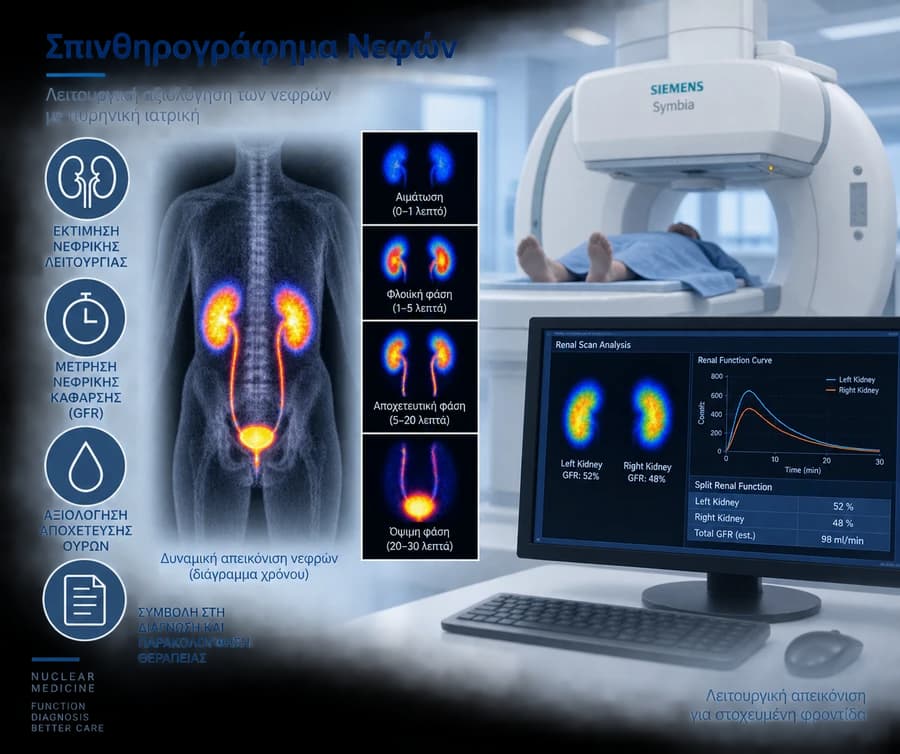
What it offers compared to other tests
Unlike purely anatomical tests, scintigraphy shows:
- the relative function of the right and left kidney
- urine drainage
- the possible functional impact of obstruction
Main indications
Often indicated in:
- hydronephrosis or suspected obstruction
- post-operative assessment of drainage
- pre-operative planning in a solitary or compromised kidney
- pediatric or congenital urological anomalies
Balanced function
A relatively even contribution from each kidney and satisfactory drainage.
Partial functional impairment
Requires closer monitoring and correlation with imaging and clinical findings.
Significant functional loss
A decisive finding for a surgical or structured treatment strategy.
How it is performed and what the curves mean
After a tracer injection, dynamic uptake and drainage curves are recorded.
In some protocols, a diuretic stress test is used to better distinguish a functional delay from true obstruction.
Impact on treatment
The result helps decide:
- monitoring versus surgical intervention
- the priority of treatment in unilateral disease
- the expected functional recovery after decompression


