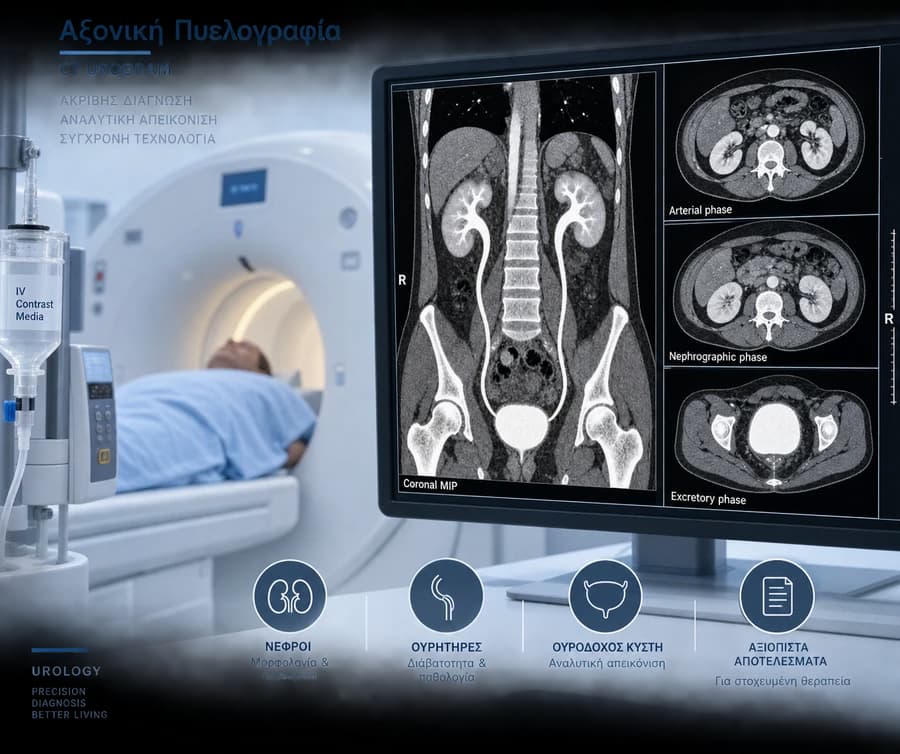
What CT urography reveals
The test images:
- the anatomy of the upper urinary tract
- stones and obstruction
- intraluminal or mural lesions
- functional drainage through contrast phases
Main indications
Often indicated in:
- investigation of hematuria
- suspected urothelial tumor
- complex stone disease or anatomical anomalies
- pre-procedural planning
No significant pathology
No focal lesions or clinically significant obstruction.
Finding requiring further work-up
An equivocal lesion or indirect signs require additional investigation.
Significant pathology
A clear mass, an obstructive lesion, or extensive disease with a direct impact on treatment.
Contrast and kidney safety
Before a contrast-enhanced CT, we assess:
- kidney function (creatinine/eGFR)
- allergy history
- coexisting conditions
Proper preparation reduces the risk of complications and increases diagnostic accuracy.
How it affects clinical decision-making
The result determines:
- the need for cystoscopy or biopsy
- the type of procedure for stone disease or obstruction
- the stage and treatment plan in oncological disease


