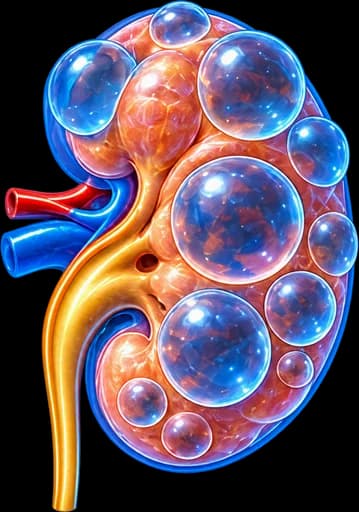
My Clinical Approach to ADPKD
Autosomal dominant polycystic kidney disease is one of the most complex chronic conditions I encounter, because it does not only affect the kidneys and does not progress the same way in any two patients. My role as a urologist focuses mainly on urological complications — stone disease, obstruction, haematuria, a suspicious mass — while long-term nephrology follow-up remains a central part of care.
The goal of this page is to give a clear, evidence-based picture of the disease — from genetics to modern risk stratification — without promising certainties that do not exist and without replacing individualised nephrology assessment.
- A clear distinction of ADPKD from incidental simple cysts and from ARPKD.
- Modern risk stratification (TKV, Mayo Imaging Classification, genotype).
- Collaboration with a nephrologist for long-term disease management.
- Prompt treatment of urological complications when they arise.
What Is Polycystic Kidney Disease (ADPKD)
ADPKD is an inherited systemic disease, not simply “cysts in the kidneys.”
It is an inherited condition with progressive formation of multiple cysts, usually affecting both kidneys. Over time the kidneys may enlarge substantially, and in selected patients there is a gradual loss of functioning parenchyma. The disease can also have extrarenal manifestations, mainly liver cysts.
Not every patient progresses towards kidney failure at the same rate. There is substantial variability, depending on genotype, age, imaging findings and other factors. We also distinguish ADPKD, very early in this page, from the much rarer autosomal recessive form (ARPKD), which mainly affects children and has a different genetic basis and presentation (see the differential diagnosis section).
Simple Kidney Cysts ? ADPKD
Multiple simple kidney cysts do not automatically mean polycystic kidney disease.
Isolated simple cysts are a very common, age-related finding, without a hereditary basis and without an effect on kidney function. ADPKD differs because it is inherited, characterised by progressive development of multiple cysts, usually affects both kidneys, can lead to substantial kidney enlargement, and can gradually affect kidney function and have extrarenal manifestations.
For the detailed evaluation of individual simple or complex cysts, the Bosniak classification, and the management of a symptomatic simple cyst, see our page on Simple Kidney Cyst.
Which Genes Cause ADPKD?
Most cases of ADPKD are associated with pathogenic variants in two main genes:
PKD1
The most frequently involved gene, encoding polycystin-1.
PKD2
Less frequently involved, encoding polycystin-2.
Modern genetics is not limited to these two genes alone — other, rarer genes have been identified that are associated with ADPKD or with ADPKD-like phenotypes, particularly in families without a detectable PKD1/PKD2 variant.
Genotype can be associated with different disease severity (e.g. certain PKD1 variants tend to be associated with faster progression compared with PKD2), but it does not predict the course of an individual patient with absolute accuracy. Each person’s clinical picture is assessed individually.
What Does “Autosomal Dominant” Inheritance Mean?
An affected parent can transmit the pathogenic variant to each of their children. Each pregnancy is an independent event as regards the probability of transmission — the outcome in one child does not affect the probability for the next.
If two children in a family have not inherited the disease, this does not mean that the next child will necessarily have it — each pregnancy is assessed independently, guided by genetic counselling.
Family History
A strong family history of ADPKD significantly increases clinical suspicion and facilitates diagnosis in first-degree relatives.
The absence of a known family history does not rule out ADPKD, due to possible de novo (new) variants, undiagnosed or mildly affected relatives, or incomplete family information.
Should Children Be Tested?
Presymptomatic screening of asymptomatic minors with an affected parent is a complex issue, involving:
There is no universal recommendation that “all children must have genetic testing.” The decision is individualised in discussion with a nephrologist/geneticist and the family, in line with current paediatric consensus recommendations.
Is Genetic Testing Needed?
Genetic testing can be particularly useful in specific situations, not as routine for every typical case:
When a known familial pathogenic variant exists, reproductive counselling may include prenatal diagnosis or preimplantation genetic testing, depending on legislation, availability and the couple’s preferences — this page does not constitute a fertility treatment protocol.
Genetic testing is not mandatory in every typical ADPKD case.
How Is the Diagnosis Made? The Role of Ultrasound
Diagnosis is usually based on a combination of family history, age and imaging findings, with genetic testing used when needed (see above). Ultrasound is often the first examination because of its accessibility, absence of ionising radiation, and ability to detect multiple cysts and assess kidney size.
Diagnostic criteria are age-dependent. Widely used unified ultrasound criteria for at-risk individuals with a family history take into account both age and the number of cysts per kidney — fewer cysts are sufficient to raise suspicion at a younger age, while more bilateral cysts are needed at an older age for the finding to be considered diagnostic, with corresponding exclusion criteria in the older age groups.
There is no simple universal rule of the type “X cysts = ADPKD” without taking age and family/genetic context into account — interpretation is always made by the treating physician.
MRI in ADPKD
MRI has greater sensitivity for detecting small cysts compared with ultrasound and can be used for:
MRI is not mandatory in every ADPKD patient — the need for it is decided by the treating physician.
What Is Total Kidney Volume (TKV)?
Total Kidney Volume (TKV) can be used as an imaging biomarker for:
- Overall disease burden.
- Prediction of the risk of progression.
- Risk stratification.
particularly in typical (bilateral, diffuse) ADPKD morphology. Because kidney size is also related to the patient’s body size, height-adjusted TKV (htTKV) is often used, so that comparisons between patients are more reliable.
TKV alone does not provide a complete prognosis — it is always assessed together with age, genotype and the trajectory of kidney function.
Mayo Imaging Classification
The Mayo Imaging Classification and TKV can help estimate the risk of progression in appropriate patients.
It uses age and height-adjusted total kidney volume (htTKV) for risk stratification in typical, bilateral cystic ADPKD morphology (Type 1), classifying patients into subclasses according to the estimated rate of kidney volume growth and the associated risk of disease progression. Atypical (non-diffuse, asymmetric) morphology is classified separately (Type 2) and assessed differently.
Important limitations:
- It is not mechanically applied to atypical morphology.
- It is not a diagnostic test on its own.
- It does not mean that a specific patient will necessarily reach a specific clinical outcome.
Rapid Disease Progression & the PROPKD Score
Identifying patients at risk of rapid progression is particularly important, because it affects the frequency of follow-up and, potentially, the indication for disease-modifying treatment (tolvaptan). The following can be considered in combination:
A single marker is not used — the assessment is always combined.
The PROPKD Score
The PROPKD score is a prognostic tool that can be used in selected, genetically characterised patients, combining clinical elements (e.g. sex, early hypertension, early urological events) with genetic data, to estimate the likelihood of rapid progression. It is not necessary in every patient and is not a self-assessment tool — its interpretation is made by the nephrologist.
Symptoms of Polycystic Kidney Disease
Many patients can be asymptomatic for a long time. Possible manifestations include:
Not every one of these symptoms occurs in every patient.
High Blood Pressure
Blood pressure is one of the most important modifiable factors to be monitored in ADPKD.
Hypertension can appear early in the course of the disease, is related to ADPKD pathophysiology itself, and is an important, modifiable risk factor. What matters is:
- Regular blood pressure measurement.
- Appropriate blood pressure control according to the treating physician's guidance.
- Overall cardiovascular risk management.
Blood pressure targets and preferred medication classes are determined by the treating physician according to current recommendations — we do not give specific dosages here.
How Is Kidney Function Affected? Creatinine & eGFR
Normal creatinine does not rule out a significant cyst burden in a younger patient.
The estimated glomerular filtration rate (eGFR) can remain normal for years despite an increasing total kidney volume, and can later gradually decline. The rate of decline varies substantially between patients.
Serum creatinine and the calculated eGFR are key monitoring markers, but their trend over time is often more useful than a single isolated measurement. See also our page on the Creatinine Test.
Proteinuria / Albuminuria
This can be assessed as part of chronic kidney disease evaluation. Significant proteinuria is not a typical finding of ADPKD — if it appears to a relatively marked degree, it may need evaluation for additional kidney disease.
Haematuria & Cyst Haemorrhage
ADPKD can be associated with haematuria due to cyst haemorrhage, stones, infection or other causes.
Not every episode of haematuria in an ADPKD patient should be automatically attributed to the cysts. Persistent or recurrent haematuria may need a full urological evaluation. See our page on Blood in Urine.
Cyst Haemorrhage
This can cause acute flank pain, gross haematuria or transient symptoms. It needs differentiation from a stone, infection, tumour or another bleeding source — a home-management protocol is not recommended without medical evaluation.
Pain in ADPKD
Pain can be acute or chronic. Possible causes include:
Not every episode of chronic back pain should automatically be considered ADPKD-related — clinical evaluation is needed.
Kidney Stones in ADPKD
Stone disease is a more common clinical issue in ADPKD patients compared with the general population, likely due to anatomical changes (urinary stasis) and metabolic factors.
For the detailed diagnosis and treatment of kidney stones, see our dedicated page on Kidney Stones — we do not repeat a detailed stone-treatment algorithm here.
Urinary Infection & Infection of a Renal or Hepatic Cyst
Patients with ADPKD may present with a lower urinary tract infection, pyelonephritis, or cyst infection — conditions that are not identical. For pyelonephritis, see our page on Pyelonephritis.
Infection of a Renal or Hepatic Cyst
Cyst infection can cause fever, localised pain, inflammatory markers and persistent symptoms, and can be difficult to differentiate clinically from uncomplicated pyelonephritis without a cyst. Treatment considerations may differ due to limited antibiotic penetration into the cyst, abscess-like behaviour, and the need for drainage in selected cases.
We do not provide a specific antibiotic regimen here — the choice is made by the treating physician.
Extrarenal Manifestations: Liver Cysts & Others
Polycystic liver disease is a very common extrarenal manifestation of ADPKD.
Most liver cysts are asymptomatic. A large liver cyst burden can cause abdominal fullness, early satiety, discomfort, or mass-effect phenomena on neighbouring organs. We do not analyse liver disease in depth here — its monitoring is carried out in collaboration with the treating physician/hepatologist where needed.
Rarer extrarenal associations that have been described include selected valvular abnormalities, colonic diverticular disease and abdominal wall hernias — mentioned here briefly, without being the target of extensive screening in every patient without a relevant indication.
ADPKD & Intracranial Aneurysms
There is an increased association of ADPKD with intracranial aneurysms compared with the general population.
This does not mean every patient needs routine brain MRI/MRA. Targeted imaging screening mainly concerns patients with:
- A personal history of aneurysm/subarachnoid haemorrhage.
- A strong family history of aneurysm.
- A high-risk occupation (e.g. pilots).
- Major elective surgery/transplant context where guidelines support it.
- Patient preference after an informed discussion with their physician.
We do not specify a particular re-screening interval here — this is determined individually by the treating physician/neurologist.
An ordinary headache does not mean an aneurysm. However, a sudden, extremely severe “thunderclap” headache — especially if different from any previous headache — requires immediate emergency evaluation.
ADPKD, Kidney Cancer & the Bosniak Classification
ADPKD does not “cause” kidney cancer in an absolute sense. The relationship between ADPKD and renal cell carcinoma (RCC) is more complex and is influenced by factors such as advanced chronic kidney disease, acquired cystic kidney disease in the context of dialysis, or the transplant setting. See our page on Kidney Cancer.
The Bosniak Classification in ADPKD
Very important: the Bosniak classification is not mechanically applied to every one of the numerous typical cysts in an ADPKD kidney. Bosniak mainly concerns the characterisation of a specific, focal, suspicious cystic mass — not the overall picture of multiple typical cysts.
If an atypical/enhancing focal lesion is found within a polycystic kidney, it needs separate renal mass work-up. For the detailed Bosniak classification, see our page on Simple Kidney Cyst.
How Is ADPKD Monitored?
Monitoring is individualised and can include:
There is no single, universal annual monitoring protocol that applies the same way to every patient — the frequency and content of follow-up are determined by the nephrologist.
Lifestyle: Water, Salt, Caffeine & Protein
Evidence-based elements include:
- Maintaining a healthy body weight.
- Regular physical activity.
- Avoiding smoking.
- Appropriate sodium intake.
- Appropriate hydration.
- Overall cardiovascular risk reduction.
Lifestyle is not a treatment that eliminates the cysts.
Water & Vasopressin
There is a biological rationale around suppressing vasopressin through adequate hydration, but excessive or unsafe instructions of the type “drink X litres a day” should not be given. Hydration advice must take into account kidney function, sodium, heart disease, medications and the risk of hyponatraemia — it is individualised by the nephrologist.
Caffeine
There is no reason for a blanket prohibition of caffeine — the approach is moderate and practical, in line with current evidence.
Salt
Sodium intake matters for blood pressure, cardiovascular risk and the progression of chronic kidney disease, without requiring an extreme diet.
Protein
High-protein diets are not recommended without clinical context. Equally, severe protein restriction is not imposed without a nephrology indication — the approach follows current CKD/ADPKD guidance.
Tolvaptan and ADPKD
Tolvaptan is not suitable for everyone; it is used in selected patients at risk of rapid progression.
Tolvaptan is a vasopressin V2-receptor antagonist — a disease-modifying treatment that can slow the increase in kidney volume and the decline in kidney function in selected patients at risk of rapid progression.
Suitability depends on factors such as age, kidney function, evidence of rapid progression (e.g. Mayo class, eGFR trajectory) and possible contraindications — according to the current approved eligibility criteria, which are determined by the treating nephrologist. We do not specify particular age/eGFR cut-offs here, as these can differ between regulatory authorities and can be updated.
What Does Tolvaptan Do?
It does not eliminate existing cysts and does not cure the genetic cause of the disease. In selected patients, it can slow the rate of progression.
Side Effects
The most common expected side effects relate to its mechanism of action: polyuria, thirst, nocturia and a risk of dehydration. Liver-related adverse effects have also been described.
Tolvaptan & the Liver — Important Safety Information.
Treatment with tolvaptan requires a baseline assessment of liver function and scheduled, regular monitoring of liver tests, with an appropriate response to any abnormal results, according to current approved prescribing requirements. We do not propose a self-management algorithm here — monitoring is carried out exclusively by the treating nephrologist.
Medications for Blood Pressure and Pain
Blood pressure control is an important part of ADPKD management. Medication classes such as ACE inhibitors or angiotensin receptor blockers (ARBs) are mentioned only in the context of current recommendations — we do not give specific dosages or prescriptions here.
As for pain, chronic NSAID use is not encouraged in patients with chronic kidney disease. Pain management must take into account kidney function, blood pressure, bleeding risk and chronicity, and should be individualised by the treating physician.
ADPKD and Pregnancy
Many women with ADPKD can have successful pregnancies. Risk is influenced by factors such as:
- Hypertension.
- Kidney function.
- Proteinuria.
- Disease severity.
Preconception counselling is needed in appropriate patients, in collaboration with a nephrologist/obstetrician. This is not a blanket high-risk statement for every woman with ADPKD — the assessment is individualised.
If there is an indication for tolvaptan, contraindications/guidance regarding pregnancy must be discussed with the treating physician according to current regulatory guidance — we do not propose self-management of medication here.
Nephrologist or Urologist?
Long-term management is mainly carried out by a nephrologist, while the urologist treats complications such as stones, obstruction, haematuria and suspicious kidney masses.
Long-term monitoring of ADPKD is mainly the nephrologist’s role: progression of chronic kidney disease, blood pressure management, risk stratification, TKV/Mayo class assessment, tolvaptan, electrolyte/metabolic issues, and dialysis/transplant planning. ADPKD is not exclusively a urological disease.
| Nephrologist | Urologist | |
|---|---|---|
| Kidney function | Primary role | Complementary |
| Hypertension/CKD | Primary role | Not the primary role |
| Tolvaptan | Specialist nephrology management | Not routine urological management |
| Stones | Collaboration | Primary interventional role |
| Obstruction | Collaboration | Primary role |
| Haematuria | Collaboration | Urological work-up where needed |
| Suspicious mass | Collaboration | Primary oncological/surgical role |
Advanced Kidney Failure & Transplantation
Selected patients may, over time, reach advanced chronic kidney disease and kidney failure, requiring dialysis or kidney transplantation. This does not happen to every patient with ADPKD.
Kidney transplantation is the preferred renal replacement therapy for suitable patients with kidney failure. ADPKD is not “transferred” to the transplanted kidney as an inherited cystic process from the donor.
Transplant eligibility is individualised and is not a simple, universal process for every patient.
Is Nephrectomy Needed in ADPKD?
Not as routine.
Nephrectomy of one’s own (native) polycystic kidneys may be considered in selected patients for reasons such as:
according to current multidisciplinary practice. Nephrectomy is not a standard treatment for ADPKD.
Drainage / Cyst Intervention
Selected dominant symptomatic cysts may, in some cases, be treated with aspiration/sclerotherapy, cyst fenestration, or another interventional technique. This does not treat overall ADPKD — disease modification should not be expected from draining a single cyst.
When Immediate Evaluation Is Needed
Seek immediate medical evaluation in case of:
A urological/nephrological emergency is always distinguished from a neurological emergency (e.g. suspected aneurysm) — both need immediate evaluation in an appropriate emergency setting.
How Fast Does ADPKD Progress? Prognosis
There is substantial variability in the rate of disease progression between patients. Risk estimation is based on a combination of factors such as genotype, age, TKV, Mayo Imaging Classification, eGFR trajectory and clinical history.
There is no universal prediction of the type “you will need dialysis in X years” — the risk varies significantly between patients.
“Will I End Up on Dialysis?”
Not necessarily.
Modern risk stratification helps identify patients with slow versus rapid progression, so that an appropriate follow-up or treatment strategy can be organised.
Can the Cysts Disappear?
ADPKD is a genetic disease, and there is currently no treatment that eliminates all cysts and corrects the genetic cause. Disease-modifying treatments (such as tolvaptan) aim to slow progression, not to cure the disease.
Differential Diagnosis: ADPKD vs Simple Cysts vs ARPKD
Multiple kidney cysts can occur in various conditions, not only ADPKD: age-related simple cysts, acquired cystic kidney disease, other hereditary cystic disorders (e.g. related to tuberous sclerosis complex, or HNF1B-related disease), and medullary cystic/tubulointerstitial disorders — mentioned only to the extent clinically relevant, without this page being a genetics textbook.
Acquired cystic kidney disease usually occurs in advanced chronic kidney disease/dialysis, is not inherited ADPKD, and has a different clinical context — it should not be confused with it.
ADPKD vs Simple Cysts
| Simple Cysts | ADPKD | |
|---|---|---|
| Inheritance | Usually not | Usually genetic |
| Number | One or more with age | Multiple, usually bilateral |
| Kidney size | Usually normal | Can enlarge substantially |
| Kidney function | Usually unaffected | Can progressively decline |
| Extrarenal manifestations | Not characteristic | Can occur (e.g. liver) |
| Family screening | Usually not needed | May be needed |
ADPKD vs ARPKD
ADPKD
- Autosomal dominant inheritance.
- More common in adults.
- Mainly related to PKD1/PKD2 and rarer genes.
ARPKD
- Autosomal recessive inheritance.
- Usually a paediatric presentation.
- A different gene/pathophysiology.
- Usually significant hepatic involvement.
The Patient’s Journey
Multiple kidney cysts / family history
An incidental finding or targeted screening due to relation to an affected relative.
Family history + blood pressure + kidney function
Initial clinical assessment.
Ultrasound
Assessment of number/distribution of cysts and kidney size.
Are typical ADPKD criteria met?
The central question, based on age and family context.
Yes ? Assessment of kidney function & complications
Checking eGFR, blood pressure, urological issues.
No/atypical ? MRI ± genetic evaluation
Further imaging or differential diagnosis.
Assessment of rapid-progression risk
TKV / Mayo Classification ± genetic data where needed.
Standard CKD/blood pressure management
In collaboration with a nephrologist.
Consideration of tolvaptan indication
If there is a risk of rapid progression.
Long-term nephrology follow-up
Alongside urological evaluation when a complication arises (stone, obstruction, haematuria, suspicious mass, symptomatic cyst).
This is an educational overview, not a rigid diagnostic/treatment algorithm — every case is discussed individually with the treating nephrologist/urologist.
Frequently Asked Questions (FAQ)
What is polycystic kidney disease?
It is mainly autosomal dominant polycystic kidney disease (ADPKD), an inherited condition in which multiple cysts progressively develop in both kidneys, with substantial variability in course from one patient to another.
Do multiple cysts always mean ADPKD?
No. The number of cysts alone is not enough — diagnosis takes into account age, family history and the distribution pattern of the cysts. A few scattered simple cysts at an older age are usually an unrelated, benign finding.
How is ADPKD inherited?
In an autosomal dominant pattern — each pregnancy of an affected parent is an independent event with a chance of transmitting the pathogenic variant. The absence of a known family history does not rule out the disease, due to de novo variants or undiagnosed relatives.
What are the PKD1 and PKD2 genes?
They are the two main genes associated with ADPKD. Variants in other, rarer genes can also be associated with an ADPKD-like phenotype. Genotype can be associated with different disease severity, but it does not predict the course of an individual patient with absolute accuracy.
Should my children be tested?
There is no universal recommendation for genetic testing in every asymptomatic minor. The decision is individualised, taking into account psychosocial, insurance and ethical considerations, while blood pressure monitoring can have value regardless of genetic status.
How is ADPKD diagnosed?
Diagnosis is usually based on a combination of family history, age and imaging findings (mainly ultrasound), with diagnostic criteria depending on age. Genetic testing is used in selected, not all, cases.
Is genetic testing always needed?
No. It can be particularly useful when imaging is equivocal, when there is no family history, at a very young age, with an atypical phenotype, or in the context of living kidney donation or reproductive planning — not as routine for every typical case.
What is Total Kidney Volume (TKV)?
It is an imaging biomarker of overall disease burden that can be used — especially in typical morphology — to estimate the risk of progression, often adjusted for the patient's height (htTKV).
What is the Mayo Imaging Classification?
It is a risk-classification system (subclasses within types 1 and 2) based on age and height-adjusted TKV, applied mainly to typical, bilateral cystic morphology — it is not a standalone diagnostic test.
Will I end up on dialysis?
Not necessarily. The risk varies significantly between patients. Modern risk stratification (genotype, age, TKV, Mayo class, eGFR trajectory) helps identify patients with slow versus rapid progression and helps tailor follow-up appropriately.
What is tolvaptan?
It is a vasopressin V2-receptor antagonist, a disease-modifying treatment that, in selected patients at risk of rapid progression, can slow the increase in kidney volume and the decline in kidney function — without eliminating cysts or curing the genetic cause.
Does every ADPKD patient need tolvaptan?
No. It is not suitable for everyone. Suitability is assessed by the nephrologist based on age, kidney function, evidence of rapid progression and contraindications, and it requires regular liver function monitoring.
Is ADPKD related to brain aneurysms?
There is an increased association compared with the general population, but this does not mean every patient needs routine brain imaging. Targeted screening mainly concerns patients with a personal or family history of aneurysm, or specific occupational/surgical circumstances.
Can ADPKD cause stones or urinary infections?
Kidney stones and urinary tract infections, including cyst infection, are more common clinical issues in ADPKD patients compared with the general population, due to anatomical and metabolic factors.
What about pregnancy in ADPKD?
Many women with ADPKD have successful pregnancies. Risk is influenced by factors such as blood pressure, kidney function and proteinuria, which is why preconception counselling is recommended in appropriate cases.
When do I need a urologist and when a nephrologist?
Long-term monitoring of the disease (blood pressure, kidney function, tolvaptan) is mainly the nephrologist's role. The urologist has an important role in stone disease, obstruction, haematuria needing investigation, a suspicious mass, or symptomatic complications requiring intervention.
Related Topics
Book Your Appointment in Rhodes
Polycystic kidney disease requires long-term nephrology follow-up, while urological assessment is particularly important when stones, obstruction, haematuria, recurrent infections, significant cyst-related symptoms, or a suspicious kidney mass appear.
References – Sources
- KDIGO Controversies Conference on Autosomal Dominant Polycystic Kidney Disease — kdigo.org
- Pei Y, et al. Unified criteria for ultrasonographic diagnosis of ADPKD. J Am Soc Nephrol 2009;20:205–212.
- Irazabal MV, et al. Imaging classification of autosomal dominant polycystic kidney disease (Mayo Imaging Classification). J Am Soc Nephrol 2015;26:160–172.
- Cornec-Le Gall E, et al. The PROPKD score: a new algorithm to predict renal survival in ADPKD. J Am Soc Nephrol 2016;27:942–951.
- Torres VE, et al. Tolvaptan in patients with autosomal dominant polycystic kidney disease (TEMPO 3:4 trial). N Engl J Med 2012;367:2407–2418.
- Torres VE, et al. Tolvaptan in later-stage autosomal dominant polycystic kidney disease (REPRISE trial). N Engl J Med 2017;377:1930–1942.
- Cornec-Le Gall E, et al. Genetics and pathogenesis of autosomal dominant polycystic kidney disease. Nat Rev Nephrol 2019;15:713–726.
Medical Editorial

Medically reviewed by Dr. Marinos Vasilas – Urologist – Andrologist
Dr. Marinos Vasilas runs a private urology practice in Rhodes, specialising in the management of urological complications of kidney disease, including polycystic kidney disease, working closely with a nephrologist for the long-term management of the disease.
View full profile


