My clinical approach
In suspected adrenal haemorrhage, the priority is recognising any adrenal insufficiency and immediately replacing corticosteroids — delay can be fatal. In parallel, we identify and treat the underlying cause.
What is adrenal haemorrhage?
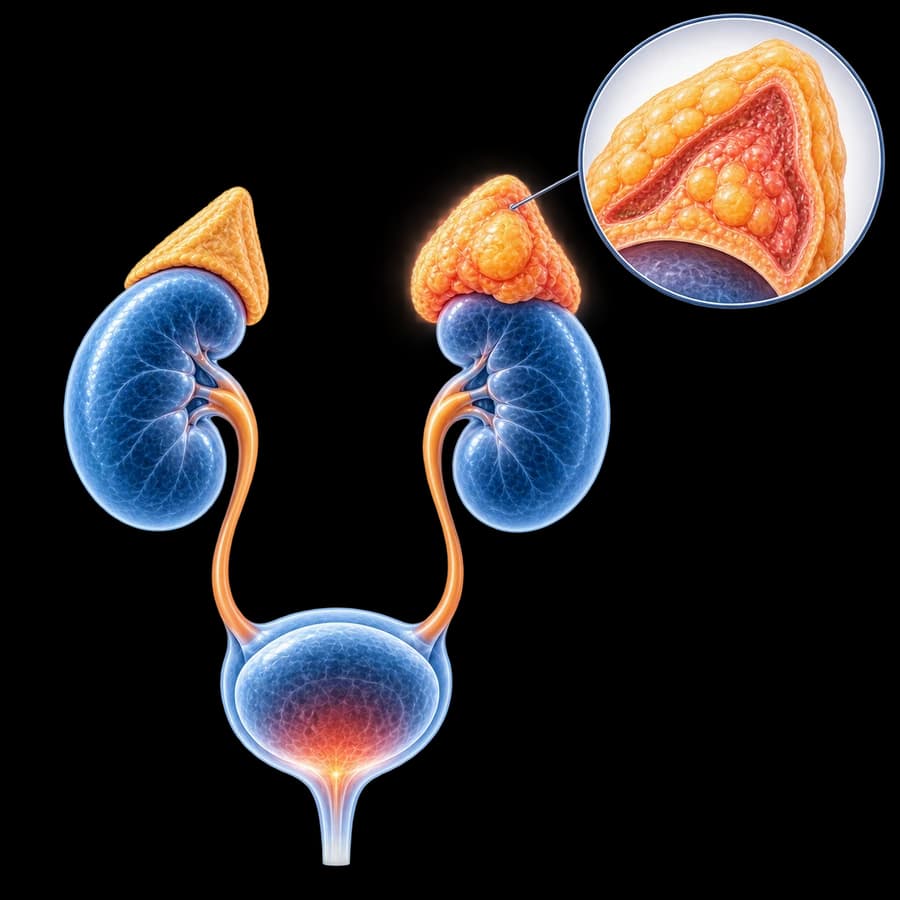
Bleeding within the adrenal parenchyma, unilateral or bilateral. Bilateral form may destroy enough functional tissue to cause acute adrenal insufficiency — a potentially fatal state requiring immediate recognition.
Causes
- Sepsis and DIC (Waterhouse-Friderichsen syndrome in meningococcaemia).
- Anticoagulation (heparin, warfarin, DOACs).
- Antiphospholipid syndrome (APS) — classic cause of bilateral haemorrhage.
- Trauma — particularly blunt abdominal trauma.
- Post-surgery, stress, burns.
- Neonatal haemorrhage (perinatal stress, large neonates).
- Heparin-Induced Thrombocytopenia (HIT).
Symptoms
- Acute back, flank or upper abdominal pain.
- Fever, nausea, vomiting.
- Hypotension, tachycardia.
- Confusion, weakness.
- In bilateral haemorrhage: Addisonian crisis (refractory hypotension, hyponatraemia, hyperkalaemia, hypoglycaemia).
Diagnosis
- Non-contrast CT: hyperdense mass (50-90 HU) in acute phase, evolving to hypodense.
- Contrast CT: search for active bleeding or underlying mass.
- MRI: very sensitive for chronic haemorrhage — signal evolves with age of bleed.
- Baseline cortisol + ACTH in bilateral haemorrhage (do not wait for ACTH stimulation test if clinically unstable).
- APS workup if recurrent bilateral haemorrhage (lupus anticoagulant, anti-β2GP1, anti-cardiolipin).
Management
- Conservative in stable patients with unilateral haemorrhage.
- Immediate IV hydrocortisone in bilateral haemorrhage or suspected adrenal insufficiency: 100 mg bolus + 200 mg/24h.
- Stop anticoagulation — individualised risk/benefit assessment.
- Treat underlying cause (sepsis, APS).
- Surgery rare — only for active bleeding or haemodynamic instability.
- Long-term monitoring of adrenal function — some patients develop chronic insufficiency.
Critical: In suspected bilateral haemorrhage with haemodynamic instability, give hydrocortisone IMMEDIATELY — do not wait for hormonal workup results.
Frequently Asked Questions (FAQ)
What is adrenal haemorrhage?
A rare condition where one or both adrenal glands bleed. Bilateral haemorrhage is dangerous and may lead to acute adrenal insufficiency.
What are the causes?
Sepsis and DIC (Waterhouse-Friderichsen syndrome in meningococcaemia), anticoagulation, antiphospholipid syndrome, trauma, post-surgical, neonatal haemorrhage (perinatal stress), HIT.
What symptoms does it cause?
Back/flank/abdominal pain, hypotension, fever, nausea, vomiting. In bilateral haemorrhage: signs of acute adrenal insufficiency (Addisonian crisis).
How is it diagnosed?
CT is the test of choice: hyperdense mass in acute phase, evolving to hypodense chronically. MRI useful in chronic haemorrhage. Hormonal workup (baseline cortisol + ACTH) in bilateral cases.
How is it managed?
Conservative in stable patients. Bilateral haemorrhage: immediate IV hydrocortisone (100 mg bolus + 200 mg/24h). Stop anticoagulation if compatible. Surgery is rare.
Related Topics
Book Your Appointment in Rhodes
Have you had an episode of adrenal haemorrhage or do you have concerns about adrenal function? Let's arrange proper evaluation and follow-up.
References
- Bornstein SR, et al. Diagnosis and treatment of primary adrenal insufficiency: an Endocrine Society clinical practice guideline (2016) — academic.oup.com
- Vella A, Nippoldt TB, Morris JC. Adrenal hemorrhage: a 25-year experience at the Mayo Clinic — Mayo Clin Proc — pubmed.ncbi.nlm.nih.gov
Medical Review

Dr. Marinos Vasilas, Urologist — Andrologist
Dr. Marinos Vasilas manages cases of adrenal haemorrhage with a comprehensive multidisciplinary approach and long-term monitoring of adrenal function.
View full profile


