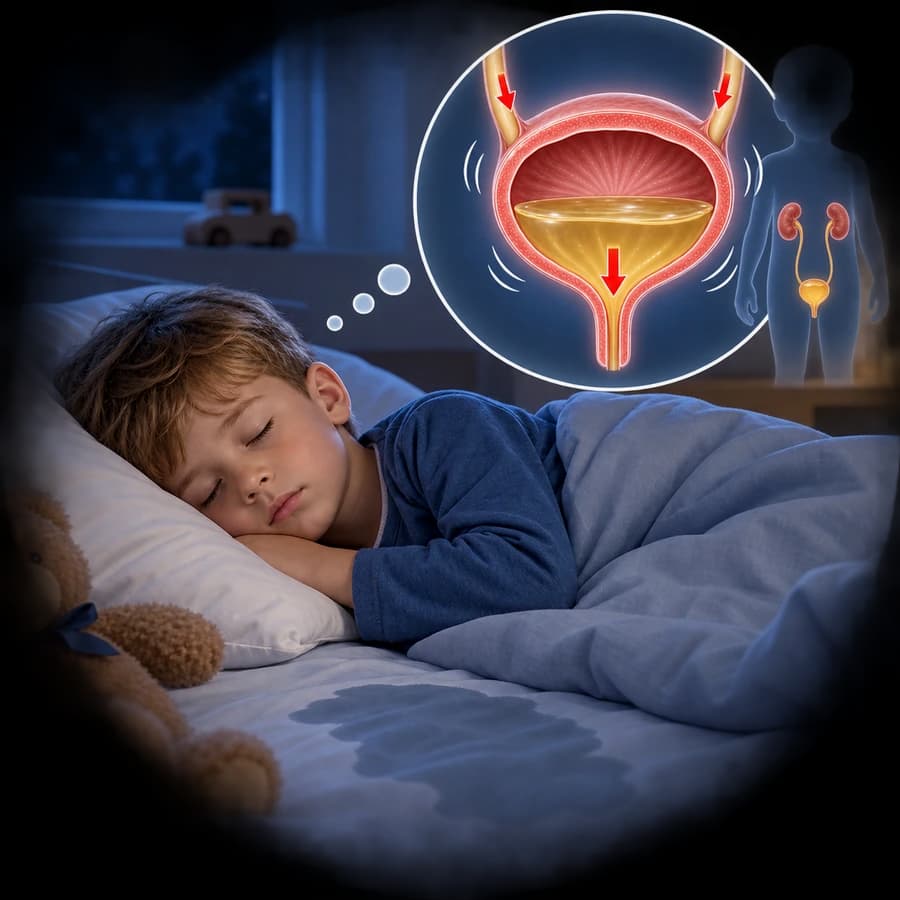
Clinical Perspective
In clinical practice, communicating well with the family is just as important as the tests themselves. Blame increases anxiety and worsens the problem. In adults, by contrast, new-onset bedwetting should always be treated as "a symptom to be investigated," not something that will simply pass on its own.
Key Takeaways
- In children, bedwetting is common and often developmental — it is not the child’s fault.
- In adults, new-onset bedwetting is always a reason for a systematic medical work-up.
- The approach should be supportive, never blaming.
- A voiding diary and checking for infection/metabolic factors are of key value.
- Red flags such as fever, pain, or neurological symptoms require prompt evaluation.
What Is Bedwetting (Nocturnal Enuresis)?
Bedwetting refers to loss of urine during sleep at an age or in a situation where bladder control would be expected.
How Patients Typically Describe It
- wets the bed
- doesn’t wake up to urinate
- bedwetting after years of being dry
- nighttime loss of urine in an adult
Symptoms That Often Occur Together
- frequent urination
- burning
- constipation
- snoring
- daytime incontinence
What Are the Most Common Causes
Functional childhood enuresis
Related to the maturation of waking mechanisms and urine production.
Urinary infection or bladder irritation
Can trigger new-onset bedwetting.
Nocturnal polyuria or sleep apnea
In adults, systemic causes must be actively investigated.
When It May Be Harmless — and When It Is Not
Less Concerning
In children with no other symptoms, it may simply be a developmental phenomenon, but it still needs proper, non-blaming guidance.
Needs Attention
The picture is more concerning when bedwetting starts suddenly after a long period of being dry, when it is combined with painful urination, fever, excessive thirst/urination, neurological signs, or significant daytime symptoms.
When Immediate Medical Evaluation Is Needed
- new bedwetting with fever
- pain on urination
- excessive thirst and urine output
- neurological symptoms
How the Diagnosis Is Made and Which Tests May Be Needed
The evaluation begins by distinguishing primary from secondary bedwetting and by recording daytime/nighttime voiding habits. Infection, metabolic disorders, and functional bladder abnormalities are then ruled out. In adults, the work-up is more extensive and individualized.
urinalysis
urine culture
voiding diary
ultrasound when indicated
How It Differs From Similar Symptoms
Must be distinguished from nocturia, urgency incontinence, and overflow leakage.
What to Expect at Your First Medical Evaluation
Before your visit, keep a 1–2 week diary of dry/wet nights, fluid intake, the time of the last void, and any daytime symptoms. For children, calm record-keeping without punishment significantly helps the clinical assessment.
The information in this article is general and does not replace an individualized medical examination. If your symptoms persist, recur, or are accompanied by red-flag warning signs, please schedule an evaluation with a urologist.
Book an appointmentFrequently Asked Questions
Is bedwetting normal in children?
It is common at younger ages and often developmental. It needs evaluation when it persists or is accompanied by other symptoms.
Is bedwetting the same in adults?
No. In an adult, new-onset bedwetting requires a systematic medical work-up for an underlying cause.
When should I be immediately concerned?
When it occurs together with fever, painful urination, excessive thirst, neurological symptoms, or sudden worsening.
Does a voiding diary help?
Yes. It is a key tool for identifying patterns and choosing the right treatment.
Should fluids be completely restricted in the evening?
Not completely. A balanced approach with proper fluid distribution and individualization is needed.
Does bedwetting always "go away on its own"?
Not always. Many cases improve, but when the problem persists, early evaluation gives better results.
Medical Review

Dr. Marinos Vasilas, Surgical Urologist — Andrologist
This content has been written and reviewed based on established urological guidelines, with the goal of providing practical, safe guidance for the initial assessment of each symptom.
View full profileSources / References
Book an Appointment for a Personalized Evaluation
If the symptom persists, recurs, or is accompanied by red-flag warning signs, prompt evaluation by a urologist supports an accurate diagnosis and targeted treatment.


