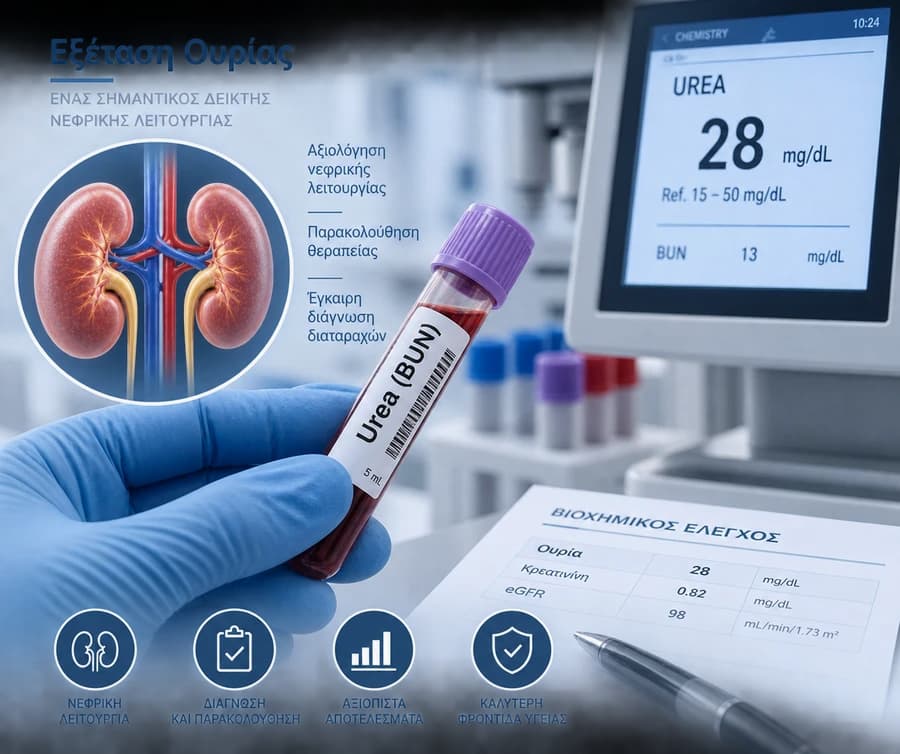
What urea shows
Urea is influenced by:
- renal clearance
- hydration status
- protein intake
- catabolic states
For this reason, it is a useful parameter, but not a sufficient one on its own.
Clinical use in urology
Useful in:
- suspected kidney dysfunction
- an acute obstructive condition
- pre-operative screening
- follow-up after treatment interventions
Consistent, stable picture
Urea and creatinine at stable levels with a normal eGFR.
Possible functional strain
Borderline increases require re-evaluation of hydration and kidney function.
Significant disturbance
High values with an abnormal clinical picture require immediate investigation.
Relationship with creatinine and eGFR
Urea becomes meaningful when considered together with:
- creatinine
- eGFR
- urinalysis
- imaging findings
Interpreting it in isolation can lead to incorrect conclusions.
Practical points for monitoring
In long-term monitoring, we assess:
- the trend of values
- accompanying symptoms
- medications and hydration status
A downward trend after treatment is often a positive prognostic sign.


