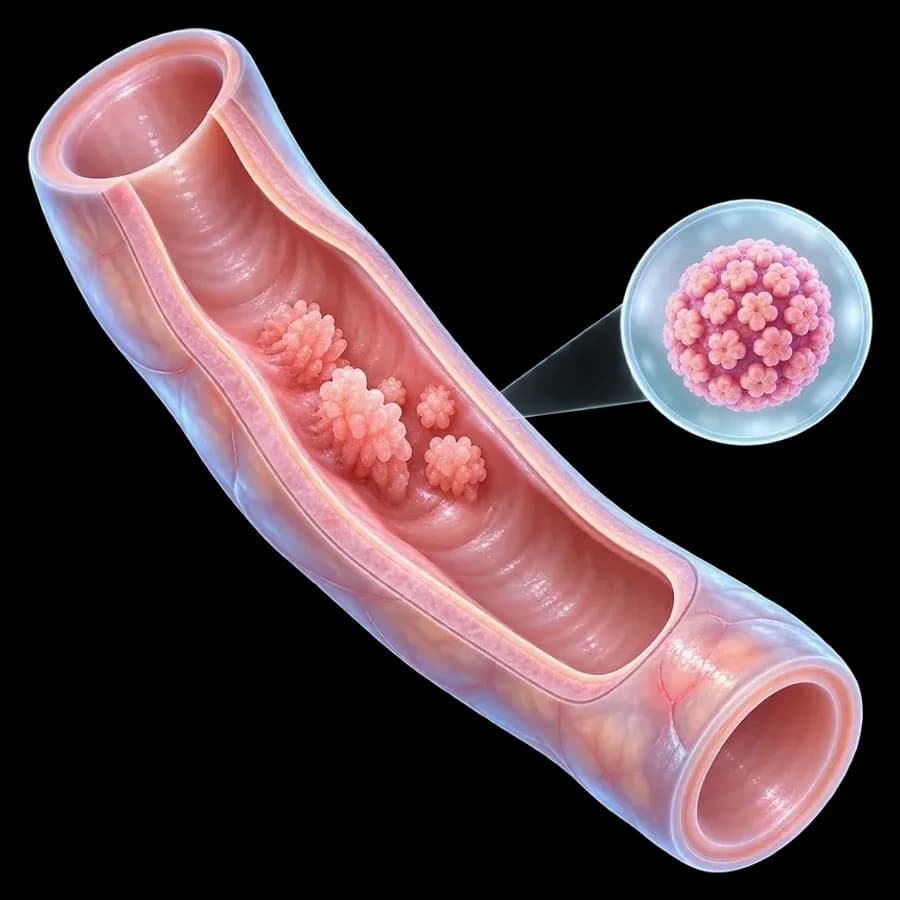
What are Urethral Warts
Urethral condylomata acuminata are papillomatous lesions caused by HPV infection. HPV-6 and HPV-11 account for ~90% of cases (low-risk strains — do not cause cancer). Less commonly HPV-16/18 (high-risk) — requires close follow-up.
Located primarily at the urethral meatus (~80%) and anterior urethra. Posterior urethral or bladder involvement is rare.
Causes & Transmission
- Sexual contact — primary route (vaginal, oral, anal).
- Frequent coexistence with external genital warts.
- Risk factors: multiple partners, young age (15–30), immunosuppression (HIV, post-transplant), smoking.
- Incubation: 2 weeks to 8 months after exposure.
- Vertical transmission to neonate during delivery (laryngeal papillomatosis).
Symptoms
- Most commonly asymptomatic.
- Palpable or visible mass at the urethral meatus.
- Hematuria or post-coital/post-voiding bleeding.
- Altered urinary stream (split or scattered stream).
- Urethral discharge.
- Pain or discomfort during urination/intercourse.
- Coexisting external warts on penis/scrotum/perineum/anus.
Diagnosis
1. Flexible urethroscopy
Gold standard. Direct visualization throughout the urethra. Concurrent biopsy for histology and HPV typing.
2. Acetic acid test (3–5%)
Application to the meatus — HPV lesions turn white (acetowhitening).
3. STI screening
HIV, syphilis, chlamydia, hepatitis B/C — mandatory. HPV vaccination (Gardasil 9) recommended for adolescents and young adults.
Treatment
Endoscopic therapy (treatment of choice)
- CO2 or Holmium laser: precise ablation with minimal damage to healthy tissue. Lower recurrence.
- Electrocautery: alternative, but higher risk of cicatricial stricture.
- Cryotherapy: for meatal lesions.
Topical pharmacologic therapy
- Imiquimod 5%: applied 3x/week for 16 weeks — immunomodulator.
- 5-Fluorouracil (5-FU) cream: intraurethral via catheter for resistant lesions.
- Podophyllotoxin 0.5%: for external warts (NOT intraurethral).
Follow-up
Recurrence ~30% in the first year. Urethroscopic surveillance at 3, 6, 12 months and annually for 2 years. Treatment of sexual partner(s) when visible lesions are present.
Prevention
- HPV vaccination (Gardasil 9): covers 9 strains — recommended for both sexes ages 9–45.
- Consistent condom use (reduces but does not eliminate risk).
- Limit number of sexual partners.
- Regular gynecologic / urologic screening.
- Smoking cessation (smoking increases HPV persistence).
FAQ on Urethral Warts
What are urethral warts?
Benign papillomatous lesions inside the urethral lumen caused by HPV infection (Human Papillomavirus), most commonly low-risk types 6 and 11.
How are they transmitted?
Almost exclusively through sexual contact. Frequently coexist with external genital warts on the penis, scrotum, perineum, or anus.
What are the symptoms?
Most are asymptomatic. Possible: hematuria, urethral discharge, altered urinary stream, palpable mass at the urethral meatus.
How are they diagnosed?
By flexible urethroscopy, allowing direct visualization and biopsy. Screening for other STIs (HIV, syphilis, chlamydia) is recommended.
How are they treated?
Endoscopic laser ablation (CO2, Holmium) or electrocautery. Topical 5-FU cream or imiquimod in selected cases. High recurrence — annual urethroscopic surveillance for 2 years.
Conclusion
Urethral warts are effectively treated with endoscopic laser ablation, but require long-term surveillance for recurrence. HPV vaccination remains the most effective preventive strategy.
Scientific References
- EAU Guidelines on Genital and Sexually Transmitted Infections 2024 — uroweb.org
- CDC. Genital HPV Infection — STI Treatment Guidelines 2021. MMWR Recomm Rep 2021;70(4).
- Sherrard J et al. 2017 European guideline on the management of genital warts. Int J STD AIDS 2018;29:1258-1272.
- Markowitz LE et al. Human Papillomavirus Vaccination — Updated Recommendations. MMWR 2019;68:698-702.
Meet the Doctor

Dr. Marinos Vasilas, Urologic Surgeon – Andrologist
Specialized in endoscopic laser ablation of urethral warts, recurrence management, and HPV vaccination strategy.
View full profile


