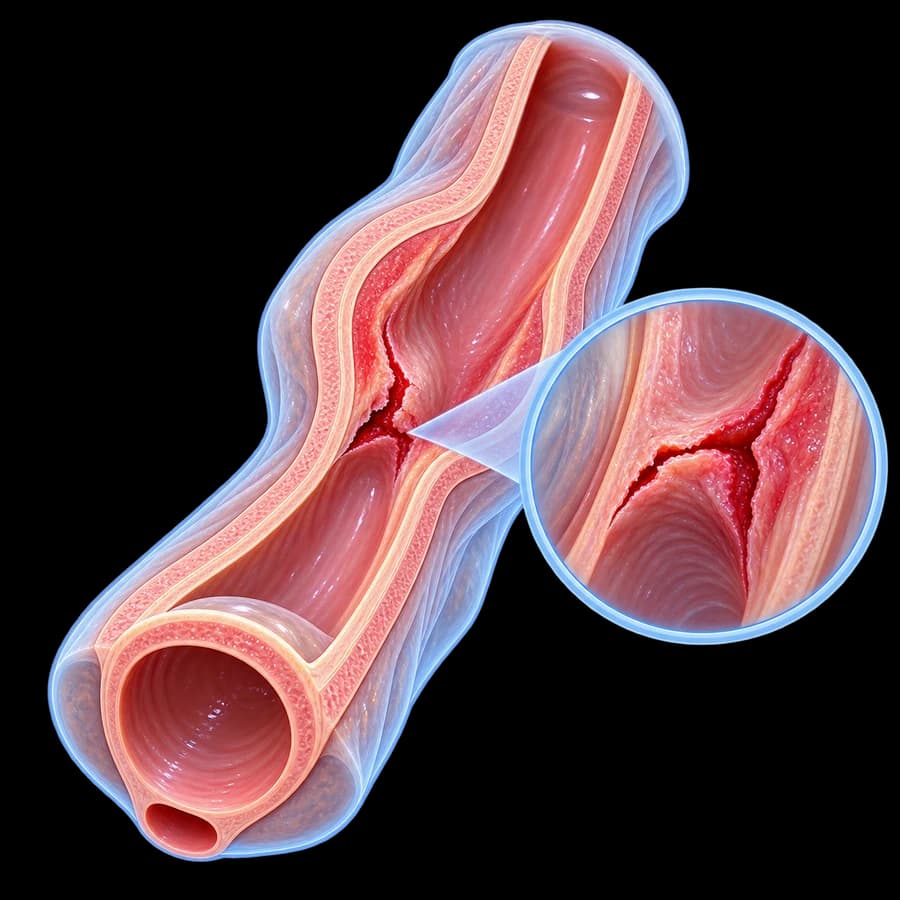
What Is a Urethral Injury
A urethral injury is a traumatic disruption ranging from stretch without rupture to complete transection. Goldman classification distinguishes 5 types:
- Type I: Stretch of posterior urethra without rupture.
- Type II: Partial rupture of posterior urethra above the urogenital diaphragm.
- Type III: Complete transection of posterior urethra extending into anterior.
- Type IV: Combined bladder neck + urethral injury.
- Type V: Complete transection of anterior urethra.
Causes
Anterior urethra (more common)
- Straddle injury: falling astride a hard object (bicycle bar, fence). Crushes the bulbar urethra between the trauma and pubic symphysis.
- Penetrating trauma: gunshot, knife wound.
- Iatrogenic: forceful catheterization, endoscopic procedures (TURP, urethrotomy).
- Sexual trauma: penile fracture, foreign body insertion.
Posterior urethra
- High-energy pelvic fractures: motor vehicle crashes, falls from height. Posterior urethral injury occurs in 10–15% of pelvic fractures.
- Crush injuries: heavy machinery, industrial accidents.
Symptoms
Classic triad of urethral injury:
- Blood at the urethral meatus (classic sign).
- Inability to urinate / acute retention.
- Hematoma / swelling in perineum, scrotum, penis (butterfly hematoma).
Additional signs:
- High-riding prostate on DRE (complete transection).
- Hematuria.
- Hemospermia in subsequent ejaculations.
- In polytrauma: hemorrhagic shock.
Diagnosis
CAUTION: DO NOT catheterize when urethral injury is suspected — perform retrograde urethrogram first.
1. Retrograde Urethrogram (RUG)
Gold standard. Demonstrates contrast extravasation — partial tear (extravasation + bladder filling) or complete transection (extravasation only).
2. CT Pelvis
Required in pelvic fracture trauma — assesses associated injuries.
3. Flexible Cystoscopy
In stable patients — performed gently under anesthesia.
4. Pelvic MRI
Delayed (3+ months) — precisely measures urethral defect length before urethroplasty.
Treatment
Acute management
- Suprapubic cystostomy: safest option. Diverts urine without further trauma.
- Early endoscopic realignment: in selected complete transections with stable fracture — bridges the urethral ends.
Delayed urethroplasty
At 3 months — after hematoma resolution and fracture stabilization. Urethroplasty type:
- End-to-end anastomosis: for defects <2 cm.
- Buccal mucosa graft urethroplasty: for defects >2 cm or complex strictures.
- Pubectomy + transpubic urethroplasty: in advanced fractures with severe displacement.
Success rate: 85–95% in expert centers.
Anterior injuries (simpler)
- Partial tear: indwelling catheter 2–3 weeks — spontaneous healing in 60–70%.
- Complete transection: cystostomy + delayed urethroplasty.
Complications & Follow-up
- Urethral stricture — most common complication (~50% if untreated).
- Erectile dysfunction (~50% in pelvic fracture cases).
- Urinary incontinence (5–15%).
- Pelvic infection (hematoma, abscess).
- Urethrocutaneous fistula (rare).
- Follow-up: uroflowmetry, urethrogram, IIEF at 3, 6, 12 months.
FAQ
What is a urethral injury?
A traumatic disruption of the urethra — partial tear or complete transection — caused by blunt trauma, penetrating trauma, iatrogenic injury (catheterization, endoscopic procedures), or sexual trauma. Classified by Goldman type I-V.
How are urethral injuries categorized?
A) Anterior urethral injuries: typically straddle injuries (fall onto a hard object). B) Posterior urethral injuries: typically associated with high-energy pelvic fractures. Goldman classification: 5 types.
What are the symptoms?
Classic triad: blood at the meatus, inability to urinate, and butterfly hematoma in perineum/scrotum/penis. High-riding prostate on DRE suggests complete posterior urethral disruption.
How is it diagnosed?
Retrograde urethrogram (RUG) is the gold standard — demonstrates contrast extravasation. CT pelvis for associated injuries; pelvic MRI for delayed planning of urethroplasty.
What is the treatment?
Anterior injuries: indwelling catheter for partial tears, suprapubic cystostomy + delayed urethroplasty for complete. Posterior injuries with pelvic fracture: emergency suprapubic cystostomy followed by delayed (3-month) urethroplasty — best functional outcomes.
Conclusion
Correct initial management of urethral injury — suprapubic cystostomy rather than forced catheterization — is the key to successful delayed urethroplasty, which delivers optimal functional outcomes.
Scientific References
- EAU Guidelines on Urological Trauma 2024 — uroweb.org
- Goldman SM et al. Blunt urethral trauma: a unified, anatomical mechanical classification. J Urol 1997;157:85-89.
- Morey AF et al. AUA Urotrauma Guideline 2014, updated 2020. J Urol.
- Mundy AR, Andrich DE. Pelvic fracture-related injuries of the bladder neck and prostate. BJU Int 2010.
Meet the Doctor

Dr. Marinos Vasilas, Urologic Surgeon – Andrologist
Specialist in emergency management and surgical reconstruction of urethral injuries — buccal mucosa urethroplasty.
View full profile


