My Clinical Approach
For cryptorchidism, I follow strictly the EAU/ESPU 2024 guidelines for surgical timing of 6-18 months. Delay beyond this significantly increases long-term risks.
In adults with undiagnosed cryptorchidism (incidentally discovered) I recommend malignancy risk assessment: if the testis is intra-abdominal or atrophic in an adult, orchiectomy is usually indicated.
I teach all patients (and parents) monthly testicular self-examination from puberty onwards, since cancer risk remains elevated even after orchiopexy.
What is Cryptorchidism?
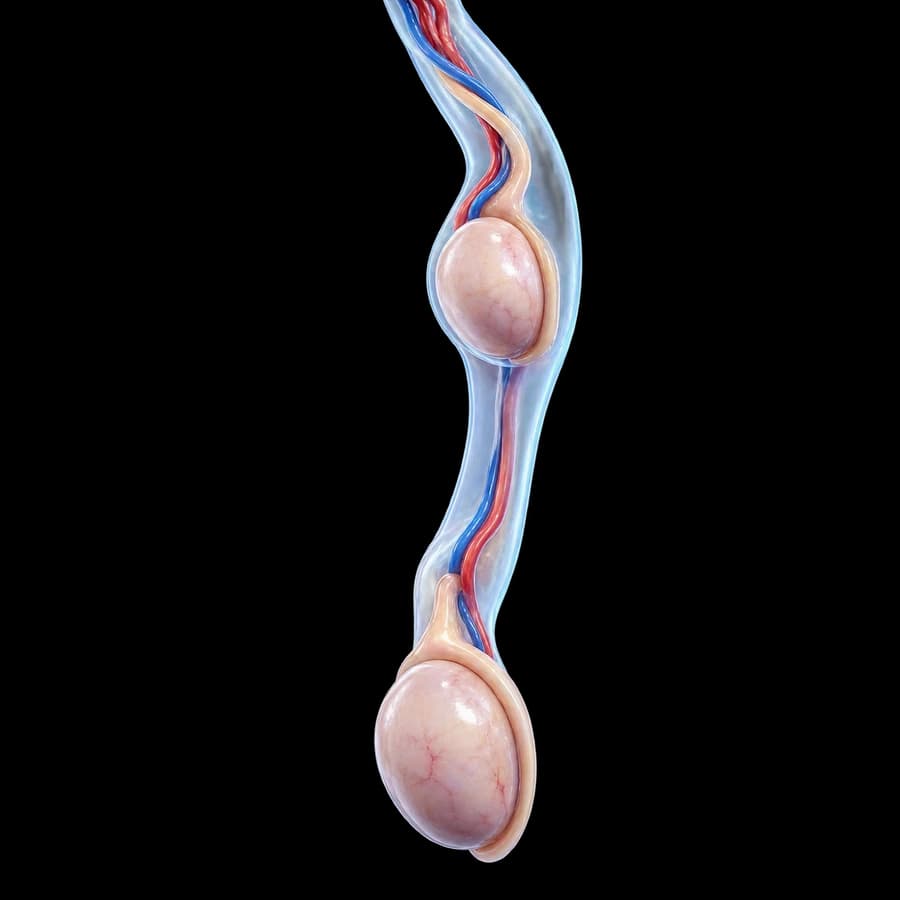
Cryptorchidism (undescended testis) is the failure of descent of the testis from the abdomen to the scrotum during fetal life. Normally, descent is completed by the 9th month of gestation.
- Frequency: 3% of term newborns, 30% of preterm
- Persists in 1% at 6 months
- 70-80% left-sided (rarer on right due to anatomy)
- 15-20% bilateral
- 20% non-palpable (intra-abdominal or aplasia)
- More common in preterm and low birth weight
Types of Cryptorchidism
True Cryptorchidism
The testis is along the normal descent pathway: intra-abdominal, intra-inguinal, high scrotal.
Ectopic Testis
The testis is outside the normal descent pathway (femoral, perineal, basal, transverse ectopic).
Ascending Testis
Acquired condition: testis that had descended but "ascended" due to failure of spermatic cord elongation with age.
Non-palpable Testis
20% of cases: intra-abdominal (40%), agenesis/aplasia (30%), small intra-inguinal (20%), vanishing after fetal torsion (10%).
Symptoms & Diagnosis
- Absence or non-palpable testis in the scrotum
- Asymmetric scrotal development
- Possible palpable mass in inguinal region
- Clinical examination in warm environment (suppression of cremasteric reflex)
- Diagnosis by neonatologist/pediatrician
- Ultrasound: limited utility (often false negatives)
- MRI/CT: for non-palpable testes
- Diagnostic laparoscopy: gold standard for non-palpable
Risks Without Treatment
- Testicular cancer: 2-8 fold increased risk (mostly seminoma)
- Infertility: 10% unilateral, 35-50% bilateral
- Testicular torsion: 10-fold increased risk
- Inguinal hernia: 90% co-occurrence
- Testicular trauma (from exposed position)
- Psychological impact (from puberty)
- Hormonal disorders (reduced testosterone)
Orchiopexy reduces but does not eliminate cancer risk. Monthly self-examination is essential for life.
Treatment (EAU/ESPU 2024)
Observation (0-6 months)
Wait for spontaneous descent. 70% descend in the first 3-6 months without intervention.
Orchiopexy (6-18 months)
- • Inguinal approach for palpable testes
- • Identification, mobilization, fixation in scrotum
- • Closure of any concomitant inguinal hernia
- • Success: 95%
- • Duration: 30-60 minutes
- • Same-day discharge
Laparoscopic Orchiopexy (non-palpable)
- • Diagnostic laparoscopy first
- • Single-stage or two-stage Fowler-Stephens
- • Success: 85% for intra-abdominal
Hormonal Therapy
hCG or GnRH: success rates 20%, high recurrence rates. Not recommended as first-line.
Recovery & Follow-up
- Same-day discharge
- Return to normal activities in 1 week
- Avoid strenuous activity 2-3 weeks
- Re-evaluation at 2 weeks (wound check)
- Re-evaluation at 3 and 12 months (testis position, growth)
- Annual testicular growth monitoring
- Hormonal evaluation at puberty
Long-term Follow-up
- Monthly self-examination education from puberty
- Semen analysis at age 18-25
- Hormonal testing (testosterone, FSH, LH)
- Testicular ultrasound every 1-2 years in high risk
- Psychological support if needed
- Fertility counseling for young adults
Frequently Asked Questions (FAQ)
When should cryptorchidism surgery be performed?
Per EAU/ESPU 2024 guidelines, orchiopexy should be performed between 6-18 months of age, ideally before 12 months. After age 2, the risk of infertility and malignancy increases significantly.
Does it increase cancer risk?
Yes. Untreated cryptorchidism increases testicular cancer risk 2-8 fold. Pre-pubertal orchiopexy reduces but does not eliminate the risk — lifelong monthly self-examination is essential.
Does it affect fertility?
Yes. Unilateral cryptorchidism is associated with 10% infertility, bilateral with 35-50%. Early orchiopexy (before 18 months) significantly reduces this risk.
Can it descend spontaneously?
In the first 6 months of life, up to 70% of undescended testes descend spontaneously. After 6 months, spontaneous descent is rare and surgical intervention is required.
What is orchiopexy?
It is the surgical descent and fixation of the testis in the scrotum. Performed via inguinal incision (palpable testes) or laparoscopically (non-palpable). Success rate 95% for palpable, 85% for intra-abdominal.
Book Your Appointment in Rhodes
Evaluation and surgical management of cryptorchidism. Timely orchiopexy at 6-18 months to reduce infertility and malignancy risks.
References – Sources
- EAU/ESPU Guidelines on Paediatric Urology, 2024 update — uroweb.org
- Kolon TF, et al. Evaluation and treatment of cryptorchidism: AUA guideline. J Urol 2014 — PMID: 24857650
- Pettersson A, et al. Age at surgery for undescended testis and risk of testicular cancer. NEJM 2007 — PMID: 17476009
Medical Review

Dr. Marinos Vasilas, Urologist – Andrologist
Dr. Marinos Vasilas runs a private urology practice in Rhodes specializing in surgical management of cryptorchidism and other paediatric urological conditions.
View full CV


