My Clinical Approach
Direct vision internal urethrotomy is one of the most widely used first-line treatments for urethral stricture, precisely because it is simple, quick, and minimally invasive. That is exactly what also makes it one of the most easily overused treatments, when applied repeatedly to strictures that will not durably benefit from a simple incision.
My approach always starts with a full mapping of the stricture — location, length, aetiology, number of previous treatments — before any treatment option is discussed. DVIU is not a solution for every stricture, and honest counselling about the likelihood of recurrence is as much a part of the treatment as the procedure itself.
- Full pre-procedure mapping (urethrography, urethroscopy where needed) before any decision.
- Clear counselling that DVIU opens the stricture, it does not remove the underlying scar.
- For a recurrent stricture after two endoscopic treatments: discussion of Optilume or urethroplasty, not automatic repetition.
- For penile or lichen sclerosus-related strictures: endoscopic incision is not the recommended first choice.
- Individualised decision-making, based on findings rather than a blanket rule.
What Is Direct Vision Internal Urethrotomy (DVIU)
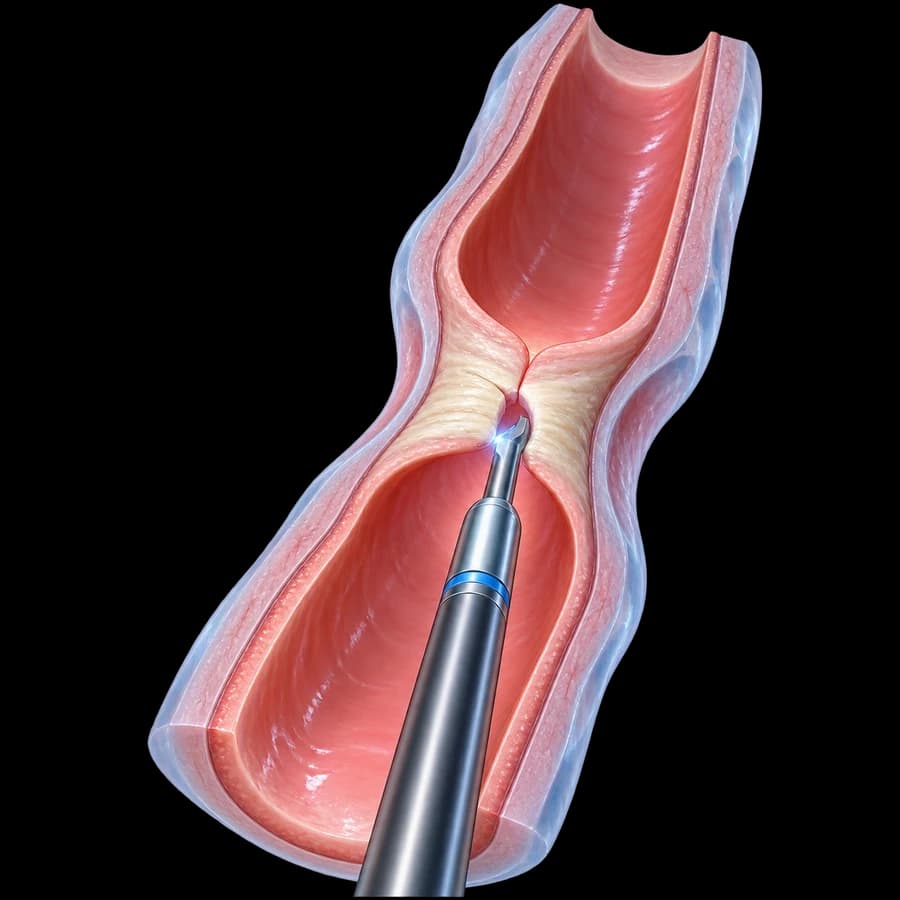
Direct Vision Internal Urethrotomy (DVIU) is an endoscopic procedure in which the scarred segment of the urethra is incised from the inside, temporarily widening the urethral lumen and improving urine flow.
Very important: DVIU does not remove the scar tissue and does not reconstruct the urethra.
It opens the stricture from within and allows the body to heal with a wider lumen. It is not suitable for every stricture, and recurrence is a fundamental limitation of the method.
In contemporary practice, DVIU is often considered a first-line treatment for selected strictures, precisely because it is simpler and faster than open reconstructive surgery — but this does not mean it is always the right choice.
DVIU, Sachse, Laser: Terminology
The broad, internationally recognised term is DVIU, which in its classic form is also referred to as Sachse urethrotomy.
"Cold knife" Sachse urethrotomy
Traditionally refers to the classic optical urethrotomy using a mechanical cold knife under direct vision.
Laser / "hot knife"
Incision of the scar tissue can also be performed with laser or bipolar energy in selected practice settings. Not every laser incision should be called "Sachse".
Both techniques belong to the same family of treatments (DVIU) — the essential difference is the cutting tool, not the underlying philosophy of the procedure.
How a Stricture Forms
Scar tissue (fibrosis) around the urethral lumen causes progressive narrowing. Possible causes include prior instrumentation or catheterisation, trauma, infection/inflammation, previous urethral surgery, lichen sclerosus, or — often — the cause remains idiopathic, with no clearly identifiable trigger.
For a full discussion of causes, symptoms, and overall treatment strategy, see the urethral stricture page. This page focuses specifically on endoscopic incision as a treatment option.
How DVIU Works
This cycle explains why DVIU is not a one-time definitive treatment for every patient: healing can reform scar tissue at the same site.
DVIU Does Not Remove the Scar
Urethrotomy opens the scarred ring, but it does not remove the entire diseased scar tissue.
During healing, fibrosis can re-form at the same site, resulting in restenosis. This explains why recurrence is a central topic in every discussion about DVIU — it is not a failure of the technique, but an inherent characteristic of the method.
Which Stricture Is Suitable for DVIU
According to EAU guidelines, DVIU has a better chance of success in selected strictures with the following characteristics:
✓ Favourable features
- First episode (no prior treatment of the same stricture)
- Single, isolated stricture
- Short length — generally under about 2cm
- Nonobliterative disease (the lumen is not nearly fully closed)
- Located in the bulbar urethra
✗ Unfavourable features
- Penile urethral stricture
- Length over 2cm as a solitary treatment
- Multifocal or extensive disease
- Near-complete obstruction (obliterative stricture)
- Recurrence after >2 prior endoscopic treatments
We do not give a single absolute length cutoff in centimetres as a universal rule — the decision is made combining all of the above characteristics, individualised per patient.
Bulbar vs Penile Stricture
The bulbar urethra is the segment near the perineum, before the urethra enters the penis. It is the location where there is the strongest evidence for selected, successful use of DVIU.
The penile urethra has different anatomy, a different recurrence risk, and a different reconstructive strategy. According to EAU guidelines, DVIU performs clearly worse in the penile urethra and may provoke venous leakage from the corpora cavernosa with a subsequent risk of erectile dysfunction — which is why its use is discouraged there. The favourable outcomes seen in the bulbar urethra should not be automatically extrapolated to the penile urethra.
Long & Obliterative Strictures
As length, fibrosis, and complexity increase, the suitability of a simple endoscopic incision strategy decreases. EAU guidelines recommend against using DVIU or dilatation as the sole treatment for long strictures (over about 2cm) — these usually require reconstructive assessment.
An obliterative stricture — near-complete or complete obstruction of the urethral lumen — is a different clinical problem from a simple, nonobliterative stricture. DVIU is not a universal solution for an obliterated urethral segment, and in such cases a reconstructive approach is discussed earlier in the diagnostic pathway.
Spongiofibrosis
Spongiofibrosis is fibrosis of the corpus spongiosum surrounding the urethra — essentially, the “depth” of the scar beyond the lumen itself.
The more extensive the spongiofibrosis, the more significant the underlying scar disease, and the more likely a reconstructive approach may be needed instead of a simple endoscopic incision. DVIU incises the lumen but does not correct the spongiofibrosis around it — this is one reason why an apparently “good” result may not be durable.
Primary Episode vs Recurrence
Selected primary episode
For a short, single, nonobliterative bulbar stricture without prior treatment, DVIU may be a reasonable first option.
Recurrent stricture
After recurrence, the chance of durable success from repeating the same endoscopic treatment decreases significantly.
Repeating the same endoscopic procedure multiple times does not necessarily mean a better long-term solution.
Diagnosis Before the Procedure
Before DVIU, we need to know the location, length, degree of narrowing, depth of fibrosis, and history of previous treatments. Tests that may be used include:
Uroflowmetry
Records urine flow, but does not on its own map the length and anatomy of the stricture.
Retrograde urethrography
Shows location, length, and degree of narrowing, as well as possible multiple strictures.
Urethroscopy
Direct endoscopic confirmation of narrowing and, where accessible, proximal anatomy.
Voiding cystourethrogram (VCUG)
Used in selected cases, particularly for posterior urethral strictures.
Ultrasound urethrography
An alternative imaging option in selected cases.
Retrograde Urethrography
Retrograde urethrography provides important information for treatment planning: site, length, calibre, and the presence of multiple strictures. This is not an optional test when an invasive treatment is being planned — it is a core mapping tool before any decision about DVIU, dilatation, or reconstruction.
Urethroscopy
Direct endoscopic examination can confirm the narrowing, lumen, and — where accessible — proximal anatomy. Where relevant, flexible cystoscopy can contribute to the evaluation of the lower urinary tract.
How the Procedure Is Performed
This description is deliberately high-level — it is not a surgical technique manual.
Cold Knife (Sachse) vs Laser
Classic optical Sachse urethrotomy uses a mechanical “cold knife” under direct vision. Incision of the scar tissue can alternatively be performed with laser (e.g. Holmium) in selected practice settings.
The available literature gives conflicting results: some randomised trials report lower recurrence with laser in the first year, others find no statistically significant difference after the first few months, while at longer-term follow-up (five years) some series show similarly low patency for both techniques. There is also conflicting evidence on complications — some studies report less bleeding with laser, others a higher rate of urinary retention.
There is no clear, consistent evidence of long-term superiority of one technique over the other. The choice depends mainly on equipment availability and surgeon experience, not on proven superiority.
DVIU vs Simple Dilatation
| Dilatation | DVIU | |
|---|---|---|
| Mechanism | Mechanical opening of the lumen | Controlled incision of the scar tissue |
| Endoscopy | Not always required | Yes, under direct vision |
| Scar removal | No | No |
| Recurrence | A relevant possibility | A relevant possibility |
| Patient selection | Important | Important |
| Definitive reconstruction | No | No |
Both are endoluminal treatments that do not reconstruct the urethra. The available literature does not demonstrate clear superiority of one method over the other in terms of long-term patency.
DVIU vs Optilume
DVIU
- • Incision of the scar tissue
- • No local drug therapy
- • Widely available method
Optilume
- • Mechanical balloon dilatation
- • Local paclitaxel delivery
- • Goal: reducing scar reformation
According to EAU guidelines, Optilume has a documented role in selected, short (under about 3cm) bulbar strictures that have already recurred after at least two prior endoscopic treatments, particularly in patients who are not suitable for or do not wish to undergo urethroplasty. It is not automatically the best choice for every stricture — its indication concerns a specific patient and disease profile.
See the full page on Optilume — drug-coated balloon dilatation for urethral stricture.
DVIU vs Urethroplasty
| DVIU | Urethroplasty | |
|---|---|---|
| Type | Endoscopic incision | Reconstructive surgery |
| Scar removal/reconstruction | No | Yes — excision or reconstruction of the scarred segment |
| Recovery | Usually shorter | Usually longer |
| Selected short primary bulbar stricture | May be suitable | May also have a role |
| Recurrent/complex stricture | Limited durability | Often the preferred definitive approach |
| Long-term durability | Lower in recurrent disease | Generally higher |
| Retreatment need | Recurrence is common | Lower retreatment need in suitable cases |
Urethroplasty is not an “excessive” treatment — it is the method that actually removes or reconstructs the scarred segment, with generally higher long-term patency in long, recurrent, or complex strictures, according to the available literature.
According to EAU guidelines, urethroplasty tends to have a stronger role in: recurrent strictures, longer strictures, penile urethral strictures, significant spongiofibrosis, failure of prior DVIU or dilatation, and lichen sclerosus-related disease.
How Many Times Can Urethrotomy Be Done?
According to EAU guidelines, repeating endoscopic urethrotomy or dilatation more than twice is not recommended when urethroplasty is a viable option for the specific patient.
Repeating the same endoscopic procedure multiple times does not necessarily mean a better long-term solution.
Repeated endoscopic procedures can increase the length and complexity of the stricture and delay definitive reconstruction, according to the available literature. The decision to “try again” with the same endoscopic treatment should be made consciously, not out of inertia.
Intermittent Self-Dilatation (ISD)
In selected patients after DVIU, intermittent self-dilatation / self-catheterisation may be used, aiming to stabilise or delay recurrence.
It is not a cure.
It carries a real day-to-day burden and can cause discomfort, infection, or trauma if not performed correctly.
It should only be used after individualised instruction from the treating physician — we do not describe technique or catheter size here.
Catheter, Anaesthesia, Hospital Stay
Catheter
A temporary urethral catheter is often placed after DVIU. The exact duration is individualised — there is no single fixed interval for every patient.
Anaesthesia
DVIU can be performed under general, spinal/regional anaesthesia, or in selected settings under local anaesthesia with or without sedation, depending on the patient and available resources.
Procedure duration
Usually a relatively short endoscopic procedure. Exact duration varies with stricture complexity.
Hospital stay
Can often be performed as a day-case or short-stay procedure in appropriate patients — this does not guarantee same-day discharge for everyone.
After Catheter Removal
Expected temporary symptoms may include dysuria, urgency, frequency, and mild haematuria. Flow may appear immediately improved — however, this initial improvement in flow does not prove that the stricture will not recur.
Haematuria
Mild haematuria can occur after an endoscopic procedure. Persistent bleeding, clots, or urinary retention need prompt assessment.
Dysuria
Transient dysuria is expected. Worsening dysuria with fever, cloudy or foul-smelling urine, or systemic symptoms may require assessment for urinary tract infection.
A universal antibiotic course is not given to every patient — the need for prophylaxis or treatment depends on preoperative urine status and the individual protocol, always in line with relevant urological infection guidelines.
Work, Exercise, Sexual Activity
Work
Return depends on catheter status, discomfort, type of occupation, and type of anaesthesia — there is no single universal return date for everyone.
Exercise / cycling
Gradual return. Activities with significant perineal pressure may need temporary restriction, without a fixed timeframe for all.
Sexual activity
Intercourse or masturbation are usually resumed after adequate urethral healing and according to the surgeon's instructions — not a single fixed date for everyone.
DVIU concerns the urethra, not the corpora cavernosa. However, it should not be presented as carrying zero sexual side effects. If the stricture affected the force of ejaculatory flow, a change may occur after treatment, without this being a universal claim for every patient.
How We Monitor for Recurrence
Follow-up usually combines symptoms, uroflowmetry, post-void residual (PVR) measurement, validated symptom questionnaires, and — where indicated — urethroscopy or urethrography. Routine invasive cystoscopy at fixed intervals is not recommended for every patient.
Urinary flow (Qmax) may improve after DVIU, but a single Qmax value should not be used as the sole definition of recurrence.
Recurrence may present as: recurrent weak stream, straining, rising post-void residual, recurrent urinary tract infections, urinary retention, or objective narrowing on imaging — diagnosis should not rely on a single symptom alone.
Success Rates: What You Should Know
A generic claim that “DVIU has X% success” without specifying location, length, primary vs recurrent disease, follow-up duration, and definition of success carries little real clinical meaning.
In the international literature, patency rates after DVIU vary widely — from about 8% to 77% in retrospective series with at least one year of follow-up — precisely because these studies include heterogeneous stricture populations and different definitions of “success”. In carefully selected patients with a first episode of a short (1–2cm), nonobliterative bulbar stricture, a five-year patency of up to about 70–71% has been reported in one of the larger series — but this does not apply universally to every patient, and most recurrences occur within the first year.
Studies may define “success” as: no need for reintervention, adequate lumen on imaging, improved flow, or symptom improvement. Percentages from different studies with different definitions of success are not always directly comparable.
Stricture After Prostate Surgery
Stenosis after transurethral resection of the prostate (TURP), thermal techniques (TURis, HoLEP), or radical prostatectomy is not always the same clinical problem — it may be an anterior urethral stricture, a bladder neck contracture, or a vesicourethral anastomotic stenosis. These are not all managed in the same way.
Bladder neck contracture
Bladder neck contracture is not the same as an anterior urethral stricture. Treatment may involve incision/resection techniques, but it is a different clinical entity — DVIU evidence from bulbar strictures should not be applied uncritically there.
Vesicourethral anastomotic stenosis
Has different anatomy, a different treatment pathway, and a different continence risk from a typical bulbar stricture, due to its proximity to the sphincter.
In stenosis close to the external sphincter or the anastomosis, endoscopic treatment can affect continence risk — it should not be presented as zero-risk for continence in every case.
Lichen Sclerosus & Traumatic Strictures
Strictures related to lichen sclerosus often have different biology and tend to be longer, involve the penile urethra, and recur more frequently. The reconstructive strategy can differ significantly — repeated DVIU is not recommended as a definitive strategy in this context.
Post-traumatic strictures may have different fibrosis, location, and severity, and often require reconstructive planning from an early stage — the indications for DVIU should not be generalised to this patient population.
Acute Urinary Retention
In acute urinary retention due to a stricture, catheterisation may be needed if it can be done safely, or a suprapubic catheter (cystostomy) may be placed when passage through the urethra is not safe — the choice depends on the anatomy and location of the stricture.
The Patient's Journey
Frequently Asked Questions
What exactly does direct vision internal urethrotomy (DVIU) do?
It cuts the scar tissue narrowing the urethra so the lumen is temporarily widened and urine flow improves. It does not remove the scar tissue and does not reconstruct the urethra — which is why recurrence remains a real risk.
Which stricture is suitable for DVIU?
According to EAU guidance, the best outcomes are expected in a first episode of a single, short (generally under about 2cm) nonobliterative stricture at the bulbar urethra. Current EAU 2026 guidelines recommend against using DVIU for penile strictures or as a solitary treatment for long strictures (over 2cm).
How many times can urethrotomy be repeated?
Guidelines recommend not repeating DVIU or dilatation more than twice when urethroplasty is a viable option, because repeated endoscopic treatment does not provide durable freedom from recurrence and can increase stricture complexity, delaying definitive reconstruction.
Is DVIU the same as Sachse urethrotomy?
Classic Sachse urethrotomy refers to 'cold knife' incision under direct vision. DVIU is the broader term covering both the cold-knife technique and alternatives using laser or bipolar energy ('hot knife'). Not every laser incision should be called 'Sachse'.
Is a catheter needed after the procedure?
Yes, a temporary urethral catheter is placed. The exact duration is individualised per patient and protocol — there is no single universally correct interval for everyone.
How is DVIU different from simple urethral dilatation?
Both are endoluminal techniques that open the stricture without removing the scar tissue. The available literature does not show a clear superiority of one method over the other in terms of long-term patency — the choice depends on availability, surgeon experience and patient preference.
Is laser better than cold knife?
Studies give conflicting results. Some randomised trials show lower short-term recurrence with laser, others find no difference after the first year, and some report similarly low patency for both techniques at five years. EAU guidelines state that either a "hot" or "cold knife" technique can be used depending on operator experience and resources, with no clear superiority of one method.
How does DVIU differ from Optilume?
DVIU incises the scar tissue without local drug therapy. Optilume combines dilatation with local paclitaxel delivery, aiming to reduce scar reformation. In selected recurrent short bulbar strictures after at least two prior failed endoscopic treatments, Optilume is one of the alternatives discussed before urethroplasty.
When should urethroplasty be preferred over DVIU?
For long, multifocal, recurrent, or lichen sclerosus-related strictures, and after repeated failure of endoscopic treatment, urethroplasty generally offers better long-term patency according to EAU guidelines.
Does DVIU affect erectile function?
DVIU concerns the urethra, not the corpora cavernosa. However, erectile dysfunction has been reported in a proportion of patients in systematic reviews, particularly when incision is applied to the penile urethra — which is why guidelines recommend against its use there.
When should I contact a specialist urgently after the procedure?
Immediately if you notice fever, significant bleeding, inability to void despite the catheter, or severe pain. After catheter removal, a persistently weak stream or difficulty voiding requires re-evaluation for possible recurrence.
Is it true that every stricture can be treated with DVIU?
No. Extensive, multifocal, obliterative (nearly complete) strictures, penile urethral strictures, and lichen sclerosus-related strictures have a much lower chance of durable success with simple endoscopic incision and are usually assessed for a reconstructive approach.
Related Topics
Urethral Stricture Assessment in Rhodes
If you are experiencing a weak or painful stream, recurrent infections, or a known urethral stricture, discuss your real options — DVIU, Optilume, or urethroplasty — with a specialist urologist in Rhodes.
Scientific References
- EAU Guidelines on Urethral Strictures 2026 — uroweb.org
- Barbagli G et al. Long-term outcome of direct vision internal urethrotomy for short bulbar urethral strictures. BJU Int.
- Greenwell TJ et al. Repeat urethrotomy and dilation for the treatment of urethral stricture are neither clinically effective nor cost-effective. BJU Int. 2004;94(7):1051–1055.
- Jin T et al. Safety and efficacy of laser and cold knife urethrotomy for urethral stricture. Systematic review.
Meet the Doctor

Dr. Marinos Vasilas, Urologist – Andrologist
Dr. Vasilas performs direct vision internal urethrotomy based on current EAU guidelines, with emphasis on correct patient selection and full pre-procedure evaluation. In cases of recurrence or complex disease, he openly discusses the alternatives — Optilume or referral for reconstructive urethroplasty — rather than automatically repeating the same endoscopic treatment.
Full Profile