My Clinical Approach
A urethral stricture that has already recurred after a previous endoscopic treatment (dilation or urethrotomy) raises a clear question: repeat the same approach, move to urethroplasty, or consider an intermediate option such as Optilume?
The decision is not based on a single criterion. It requires precise mapping of the location and length of the stricture, knowledge of the treatment history, and an honest discussion with the patient about the likelihood of success of each option.
- Precise stricture mapping (location, length, anatomy) before any decision.
- Recording the number and type of previous endoscopic treatments.
- Information on Optilume, DVIU/dilation and urethroplasty — without bias towards one method.
- Clear information on paclitaxel safety data, particularly regarding semen.
- Individualised follow-up after the procedure.
Key message: Optilume is not a suitable treatment for every urethral stricture — location, length and treatment history are critical.
What Is Optilume
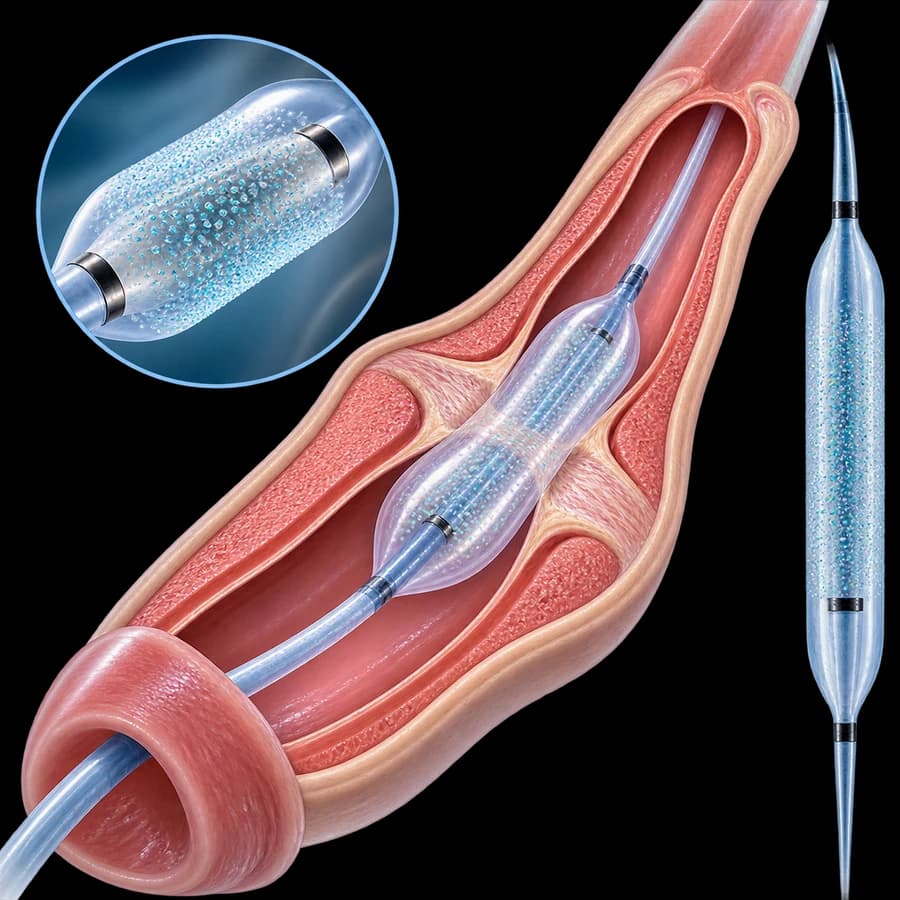
Optilume® is a drug-coated balloon designed to treat selected strictures of the male urethra. The system consists of a balloon catheter, whose surface carries a paclitaxel coating.
Optilume ≠ simple dilation. Plain dilation only mechanically widens the stricture. Optilume adds local paclitaxel delivery.
Optilume ≠ urethroplasty, and it is not a suitable treatment for every urethral stricture. Its indication concerns a specific patient category.
During the procedure: (1) the narrowed segment is identified endoscopically, (2) it is prepared/dilated according to the appropriate protocol, (3) the drug-coated balloon is placed at the stricture, (4) the balloon is inflated, and (5) paclitaxel is transferred locally to the urethral tissue.
The Role of Paclitaxel
Paclitaxel is an anti-proliferative agent used here locally, at the site of the stricture, to limit the excessive cellular/scar regeneration that follows dilation.
This is local drug delivery via a coated balloon and is not equivalent to systemic chemotherapy — the patient is not "having chemotherapy". Paclitaxel does not eliminate the possibility of new scarring, it only aims to reduce it.
How Optilume Works
1. Mechanical Dilation
The balloon widens the stricture area — as with a plain dilation.
2. Local Drug Delivery
Paclitaxel is transferred to the urethral tissue and limits the proliferative/scar response that follows dilation.
Key message: Optilume is not simply "a bigger balloon" — the combination of mechanical dilation and local drug therapy is what differentiates it.
Who May Be Suitable
According to current EAU guidance on urethral strictures, patient selection for Optilume depends on a combination of factors:
The strongest current EAU recommendation concerns a short (<3cm) bulbar urethral stricture recurring after at least two prior endoscopic treatments, in patients not fit for, or unwilling to undergo, urethroplasty.
Optilume is not suitable for every urethral stricture. Use at other locations (e.g. penile urethra, posterior urethra), longer strictures, without prior treatment, or after failed urethroplasty is based on more limited data — current guidance states that evidence outside this framework remains too limited for clear recommendations.
What Is the Bulbar Urethra
The bulbar urethra is the segment of the male urethra located at the base of the scrotum/perineum, between the penile (mobile) urethra and the posterior (membranous/prostatic) urethra. It is the most common location of strictures studied in the Optilume clinical trials.
Results from bulbar urethra studies should not be automatically generalised to penile strictures, meatal strictures, long strictures, or complex panurethral disease — these categories have different biology and different evidence.
Stricture Length & Primary vs Recurrent
The strongest evidence base (ROBUST studies) concerns bulbar urethral strictures shorter than 3 centimetres. This threshold comes from the inclusion criteria of these specific studies and is not a universal cutoff for every urethral stricture.
Primary / Untreated Stricture
A short, primary stricture may have a different treatment pathway — often plain dilation or DVIU is considered first, not necessarily Optilume.
Recurrent Stricture
Has already recurred after a previous endoscopic treatment. Optilume has its strongest evidence exactly in this category — a recurrent, short (<3cm) bulbar stricture after at least two prior failed endoscopic treatments.
Optilume is not presented as an automatic first endoscopic treatment for every new stricture diagnosis, as this is not supported by current guidance.
Urethral Stricture Symptoms
A weak urinary stream, straining, spraying, prolonged voiding, a sense of incomplete emptying, recurrent urinary tract infections, or urinary retention may suggest a urethral stricture.
For a full discussion of causes, diagnosis and overall treatment strategy, see the detailed page on urethral stricture.
How the Stricture Is Confirmed
Before any treatment decision, it is important to know the location, length, calibre and complexity of the stricture, as well as the history of previous interventions. Depending on the case, the following may be used:
Uroflowmetry
May record a reduced Qmax and a characteristic low/plateau flow pattern. It does not by itself determine the length or exact anatomy of the stricture.
Post-Void Residual (PVR)
Helps assess the severity of obstruction.
Flexible Urethroscopy/Cystoscopy
Can help with confirmation, direct visualisation and assessment of the urethral lumen. See the page on flexible cystoscopy.
Retrograde Urethrogram (± VCUG)
Has particular value for stricture length, location and anatomy, especially when definitive treatment is being planned.
Ultrasound Urethrography
May be used in selected cases as a complementary tool.
Cystoscopy and urethrography are not interchangeable in every situation — they offer different, often complementary, information.
Optilume vs Simple Dilation vs DVIU
| Plain Dilation | Optilume | |
|---|---|---|
| Mechanical widening | Yes | Yes |
| Drug coating | No | Paclitaxel |
| Goal | Open the stricture | Open + limit scar reformation |
| Evidence | Established method; recurrence remains relevant | Specific evidence in recurrent strictures |
| Suitable for everyone | No | No |
| DVIU (Internal Urethrotomy) | Optilume | |
|---|---|---|
| Mechanism | Endoscopic incision of the stricture | Dilation + local paclitaxel delivery |
| Invasiveness | Endoscopic | Endoscopic |
| Patient selection | Broader, often a first endoscopic option | Mainly recurrent stricture after ≥2 prior failed treatments |
| Recurrence evidence | Established method, known recurrence risk | Specific comparative data (ROBUST) in recurrent disease |
| Role after prior endoscopic treatment | Repeating DVIU/dilation has limitations | Alternative option in selected patients |
| Availability | Widely available | Depends on centre/equipment |
Optilume vs Urethroplasty
| Optilume | Urethroplasty | |
|---|---|---|
| Type | Endoscopic / minimally invasive | Reconstructive surgery |
| Hospital burden | Usually smaller | Greater |
| Tissue reconstruction | No | Yes |
| Selected short recurrent stricture | May have a role | Yes, case by case |
| Long/complex disease | Limited role | Often the definitive strategy |
| Long-term durability | Improving evidence, different profile | Generally the strongest documented reconstructive durability |
| Recovery | Usually shorter | Longer |
| Patient selection | Very important | Very important |
Being less invasive does not mean Optilume is functionally "better" than urethroplasty — these are different treatment strategies, with different roles depending on the characteristics of the stricture and the patient.
Urethroplasty is particularly considered for longer strictures, complex disease, multiple recurrences, significant spongiofibrosis, selected penile strictures, failure of repeated endoscopic treatments, or when durable, reconstructive treatment is the priority, according to current EAU guidance.
Why Not Just Keep Dilating?
Current EAU guidance notes that repeated dilation/DVIU in recurrent disease can:
This does not mean every second dilation is "wrong" — the choice depends on the stricture characteristics and patient preference. It is exactly at this point, when guidance discourages a third or further repeated endoscopic treatment, that Optilume or urethroplasty become the main alternatives.
Preparation, Anaesthesia & The Procedure
Imaging before the procedure
Urethrogram and/or cystoscopy for precise mapping of the location, length and anatomy of the stricture.
Urinary infection screening
The need for urine culture/analysis before invasive urethral endoscopy depends on symptoms, risk factors and local protocol — it is not a one-size-fits-all rule.
Medications & anticoagulants
Recording all medications. Management of anticoagulants/antiplatelets is individualised — see the callout below.
Information on paclitaxel & semen
Discussed before the procedure, especially for patients with a partner of childbearing potential — see the "Paclitaxel, Semen & Contraception" section.
Do not stop anticoagulants or antiplatelets on your own. Perioperative management is individualised according to thrombotic risk, bleeding risk, and the anaesthetic/surgical plan.
Anaesthesia
The procedure is performed in an operating-room/endoscopy environment, with general, spinal, or another suitable anaesthetic strategy, depending on the patient, the stricture location, and the local protocol — it is not always performed without anaesthesia.
What Happens During the Procedure
Catheter after Optilume
A temporary urethral catheter is usually placed for a period after the procedure, to allow the tissue to heal. The exact duration is individualised by the surgeon, according to the current protocol and device documentation — there is no single fixed duration for everyone.
Some modern drug-coated balloons rely on local drug-release technology during inflation — this is part of the mechanism of action, not a guarantee of outcome.
Paclitaxel, Semen & Contraception
In clinical studies, paclitaxel has been detected in semen for up to six months after Optilume treatment.
For this reason, barrier contraception (condom) is recommended during sexual intercourse when the partner has childbearing potential, for the corresponding period.
Two separate issues must be distinguished:
1. Wound/urethral healing
Determines when it is safe to resume sexual activity from the perspective of local healing.
2. Paclitaxel-related precautions
Concerns exclusively the use of barrier contraception due to possible presence of paclitaxel in semen — an independent issue from local healing.
Exact recommendations on contraception, partner pregnancy precautions, and the duration of precautions should always be confirmed with the current official device Instructions for Use (IFU) and the treating surgeon, as these may be updated.
Sexual Function & Ejaculation
Optilume targets the urethra, not the erectile tissue responsible for erection. In the available clinical data, no negative effect on erectile function has been observed, without this being able to promise zero risk of a sexual adverse event in every patient.
Optilume is not a treatment for ejaculation. Any concerns about ejaculation, semen volume, or fertility should be assessed separately from urethral patency — they are not the same thing.
Possible Complications
Based on the available trials and device documentation, possible complications include:
In the ROBUST III trial, no serious adverse events related to the drug-coated balloon were reported, while a higher rate of transient dysuria was observed in the Optilume group compared with the control arm.
Contact your surgeon immediately in case of heavy or persistent haematuria, inability to urinate, fever, or persistent pain.
Recurrence & What Happens Next
Optilume reduces the risk of restenosis in suitable patients compared with conventional endoscopic therapy in the available data, but it does not eliminate the possibility of recurrence. It is not a "definitive cure" that guarantees it "will not narrow again" in every patient.
In case of recurrence, the location, length, treatment history and patient preference are reassessed. Options may include:
Whether repeat Optilume treatment is possible and appropriate depends on the findings and individual history — data on repeated use remain more limited than for a first treatment. A failed Optilume treatment does not exclude subsequent urethroplasty, although the surgeon will assess whether the stricture has become more complex.
What the Clinical Trials Show (ROBUST)
Data on Optilume come mainly from the ROBUST study programme, as summarised in current EAU guidance on urethral strictures:
ROBUST III (randomised controlled trial)
Patients with predominantly bulbar strictures <3cm and at least two prior failed endoscopic treatments were randomised to Optilume (n=79) or standard dilation/DVIU (n=48). Anatomic patency (by cystoscopy) at 6 months was 75% for Optilume versus 27% for standard treatment. Estimated retreatment-free survival was 77.8% at 2 years for Optilume, versus 23.6% at 1 year for the standard group.
ROBUST I (prospective, single-arm study)
Patients with bulbar stricture <2cm and 1–4 prior endoluminal interventions. Estimated retreatment-free survival at 5 years was 71.7%. Functional success (>50% symptom improvement without retreatment) at 5 years was 58%, with better results for the larger balloon size.
No serious adverse events related to the drug-coated balloon, and no negative effect on erectile function, were reported in these studies.
These results concern a specific patient population (mainly bulbar stricture, specific length, specific treatment history, specific follow-up duration) and should not be equated with a universal, guaranteed "lifelong cure" for every patient. Use outside this framework (other anatomical location, longer strictures, no prior treatment, after failed urethroplasty) is based on much more limited data, according to EAU guidance.
Special Stricture Situations
Penile urethral stricture
Optilume data mainly concern the bulbar urethra. They should not automatically be generalised to the penile urethra, which has different biology and a different response to endoscopic treatments.
Meatal / fossa navicularis stricture
Anatomy and treatment approach differ significantly. Optilume is not presented as an established treatment here without strong evidence — reconstructive techniques are often preferred.
Long or multifocal/panurethral stricture
Usually requires different reconstructive thinking and should not be treated as equivalent to a short, recurrent bulbar stricture.
Stricture related to lichen sclerosus
This represents a different, more complex disease biology. The reconstructive strategy often differs significantly, and Optilume is not presented as a routine definitive treatment in this category.
Stricture after TURP/HoLEP/prostate surgery
Can occur at different urethral locations. Suitability for Optilume depends on the exact anatomy, length, proximity to the sphincter and treatment history — not every postoperative stricture is an automatic candidate.
Bladder neck contracture ≠ urethral stricture
Bladder neck contracture or vesicourethral anastomotic stenosis after radical prostatectomy is a different entity from anterior urethral stricture. Optilume evidence for bulbar urethral stricture does not automatically apply to these conditions without strong, specific evidence.
Recovery & Follow-up
Endoscopic treatment, temporary catheter where required.
Catheter in place (if any). Possible mild dysuria/haematuria.
Monitoring of urinary stream. Possible transient irritation.
Symptom assessment, uroflowmetry/PVR where appropriate.
Reassessment for possible restenosis if symptoms return.
Work
Depends on the catheter, urinary symptoms, type of work, discomfort, and anaesthesia. Office work is usually permitted sooner than physical work.
Exercise / Cycling
Gradual return. Activities that put pressure on the perineum (cycling, horse riding) may need temporary avoidance, according to the surgeon's instructions.
How Is Follow-up Done?
Follow-up usually includes symptom assessment, uroflowmetry, and measurement of post-void residual (PVR). Urethroscopy or imaging are used where clinically indicated, not as routine in every asymptomatic patient.
What does success mean? Depending on the study/context, it may include symptom improvement, improved urinary flow, no need for retreatment, or anatomical patency on imaging/cystoscopy. Different trials use different definitions — uroflowmetry (Qmax) is an objective marker, but should not be used alone as the sole criterion of success/recurrence.
The Patient Journey
This journey is educational and not a rigid mandatory sequence for every patient.
Frequently Asked Questions (FAQ)
What is Optilume?
Optilume is a drug-coated balloon used to treat selected strictures of the male urethra. It combines mechanical dilation of the stricture with local release of paclitaxel, aiming to reduce hyperplastic scarring and the likelihood of recurrence.
How does Optilume work?
In two steps: first the balloon mechanically dilates the narrowed segment of the urethra, as with a plain dilation; then the paclitaxel coating the balloon is transferred locally to the urethral tissue, limiting the excessive cellular/scar regeneration that usually follows dilation.
What is paclitaxel and why is it used?
It is a drug with anti-proliferative action, known mainly from its use on coated vascular balloons. In Optilume it is used locally, on the balloon, to limit fibroblast proliferation at the stricture site. This local use is not equivalent to systemic chemotherapy.
Is Optilume the same as simple urethral dilation?
No. Plain dilation only mechanically widens the stricture. Optilume adds local paclitaxel delivery, aiming to limit scar reformation — it is not simply a "bigger balloon".
Which strictures is Optilume used for?
The strongest evidence, according to current EAU guidance, concerns short (<3cm) bulbar urethral strictures that have recurred after at least two prior endoscopic treatments, in patients not fit for, or unwilling to undergo, urethroplasty. Use outside this context (other locations, longer strictures, no prior treatment) is based on more limited data.
Is it used for a first stricture episode or mainly for recurrence?
The strongest data concern recurrent strictures, after at least two failed endoscopic treatments. It is not presented as an automatic first-line treatment for every new stricture diagnosis.
How long can the stricture be for Optilume to be considered?
The strongest evidence base (ROBUST studies) concerns bulbar urethral strictures shorter than 3 centimetres. For longer or more complex strictures, urethroplasty usually remains the preferred approach.
What is the difference between Optilume and DVIU (internal urethrotomy)?
DVIU opens the stricture with an incision, while Optilume mechanically dilates it and adds local paclitaxel. Both are endoscopic methods, but Optilume has specific data in recurrent strictures after prior failed endoscopic treatment.
What is the difference between Optilume and urethroplasty?
Urethroplasty is an open, reconstructive operation that removes/replaces the scarred segment, with the strongest documented long-term durability for many strictures. Optilume is an endoscopic, less invasive method, with a role in selected, short, recurrent strictures. It is not correct to compare them simply as "better/worse" — they are different treatment strategies.
Is anaesthesia required?
Yes. The procedure is performed in a surgical/endoscopic setting, with general, spinal, or another suitable anaesthetic strategy depending on the patient and protocol.
Is a catheter needed after Optilume?
A temporary urethral catheter is usually placed for a period after the procedure, to allow the tissue to heal. The exact duration is individualised by the surgeon, according to the current device protocol.
Does it hurt afterwards?
There may be transient burning/discomfort on urination for some days after catheter removal. Severe or persistent pain needs assessment.
Can the urethra narrow again after Optilume?
Yes, there is always a possibility of recurrence. According to the ROBUST studies, Optilume has shown a reduced need for retreatment in suitable patients with recurrent stricture compared with conventional endoscopic therapy, but it does not guarantee a permanent cure.
Does a balloon or stent remain inside the urethra?
No. The drug-coated balloon is removed at the end of the procedure. It is not a permanent urethral stent. A temporary urethral catheter may remain for a few days.
Is sexual function affected?
Optilume targets the urethra, not the erectile tissue. In the available data, no negative effect on erectile function has been observed, but no method can promise zero risk of a sexual adverse event.
Is there paclitaxel in the semen after treatment?
Yes — in clinical studies, paclitaxel has been detected in semen for up to six months after treatment. For this reason, barrier contraception (condom) is recommended if the partner has childbearing potential, for the corresponding period.
Is contraception/a condom needed after treatment?
Yes, according to safety data, due to the presence of paclitaxel in semen for up to six months after treatment. The exact recommendation should always be confirmed with the current official device Instructions for Use (IFU) and the treating surgeon.
When can I return to work?
It depends on the catheter, urinary symptoms, type of work, discomfort, and anaesthesia. Office work is usually permitted sooner than physical work.
What happens if Optilume fails?
In case of recurrence, reassessment takes place: depending on location, length, treatment history and patient preference, options include repeat endoscopic treatment where appropriate, or urethroplasty.
Can I still have urethroplasty afterwards?
Yes, a failed Optilume treatment does not exclude urethroplasty. However, as with any repeated endoscopic treatment, the surgeon will assess whether the stricture has become more complex, which may affect the planning of the open procedure.
Urethral Stricture Evaluation
The choice between Optilume, conventional endoscopic therapy, and urethroplasty depends on the location and length of the stricture, the degree of scarring, and the history of previous procedures. Precise mapping of the stricture is essential before deciding which method offers the best chance of long-term success for a given patient.
References
- EAU Guidelines on Urethral Strictures 2026 — uroweb.org (primary source for all ROBUST I/III quantitative data, patient-selection criteria, and the duration of paclitaxel detection in semen referenced on this page).
Medical Disclaimer
The content of this page is informational and does not replace an individualised urological assessment. Suitability for Optilume depends on the exact anatomy, length, and treatment history of each patient. Exact recommendations on catheter duration, contraception, and paclitaxel-related precautions should always be confirmed with the current official device Instructions for Use (IFU) and the treating surgeon.
Medical Review

Dr. Marinos Vasilas, Urologist – Andrologist
Dr. Vasilas assesses urethral strictures with precise mapping of location and length before any treatment decision. The choice between dilation, DVIU, Optilume, and urethroplasty is always based on an individualised assessment.
Full Profile