My Clinical Approach
TURBT is one of the most critical procedures in urological oncology, because its quality directly affects staging accuracy and the planning of any subsequent treatment. Many patients confuse it with a simple “polyp removal” or with office-based flexible cystoscopy, when in fact it is a distinct, interventional procedure with a clear diagnostic, staging, and often therapeutic role.
My approach emphasises completeness of resection, correct tissue sampling including detrusor muscle where required, and clear communication that the final treatment strategy is determined by the pathology report and risk category — not only by the visual appearance during the procedure.
- TURBT is not simply the removal of a "polyp".
- It is not the same as office-based flexible cystoscopy.
- It is not the same as radical cystectomy.
- It does not guarantee zero risk of recurrence or microscopic disease.
What Is TURBT
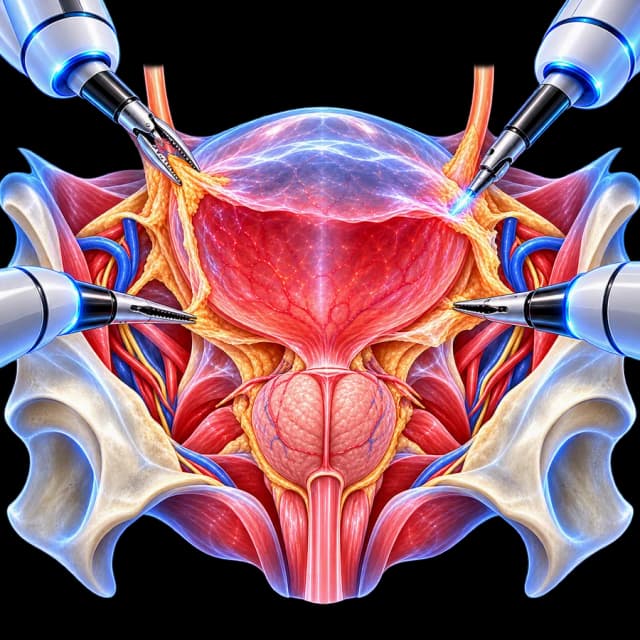
TURBT (Transurethral Resection of Bladder Tumour) is an endoscopic procedure performed through the urethra, without an external surgical incision, in which a suspicious bladder tumour is removed or sampled and sent for histological examination.
TURBT has a diagnostic, staging, and — in many non-muscle-invasive tumours — therapeutic role. But TURBT ≠ always definitive treatment for bladder cancer.

“Bladder Polyp” – A Note on Terminology
Patients often use the term “bladder polyp” to describe a projecting lesion found on cystoscopy or imaging.
The endoscopic appearance alone does not determine whether it is cancer, nor its grade or stage. Histological examination is required for a definitive classification.
What Are the Goals of a Proper TURBT
TURBT should not be presented only as “burning the tumour”.
Diagnosis, Staging & Treatment Together
TURBT is not simply a biopsy.
In many NMIBC tumours, it:
But further management may still require:
Flexible Cystoscopy vs TURBT
Flexible Cystoscopy
Sees the suspicious lesion.
TURBT
Removes/samples the lesion and provides tissue for histological diagnosis and staging.
See also the page on Flexible Cystoscopy for the diagnostic role of visual inspection before any TURBT.
Why It Is Important to Have Detrusor Muscle in the Specimen
The bladder wall includes:
The presence of detrusor muscle in an appropriate specimen helps determine whether the tumour remains superficial to the muscle or invades it.
The absence of detrusor muscle in the specimen is associated with a significantly higher risk of residual disease and tumour under-staging, and according to current EAU guidance is an indication for a second TURBT – with the exception of Ta low-grade (LG/G1) tumours and primary CIS.
The Bladder Wall & Staging
Grade ≠ Stage.
Ta ≠ T1 ≠ CIS ≠ T2
| Finding | Meaning |
|---|---|
| Ta | Papillary non-invasive tumour |
| T1 | Invasion into lamina propria, not muscle |
| CIS / Tis | Flat high-grade intraepithelial carcinoma |
| T2 | Invasion of muscularis propria |
Current WHO/EAU terminology is used — the older term “superficial bladder cancer” is not used here as the primary modern term instead of NMIBC.
Grade ≠ Stage
Grade
Describes cellular aggressiveness.
Stage
Describes depth/extent of invasion.
A tumour can therefore be high-grade but non-muscle-invasive, or muscle-invasive, depending on the pathology. This distinction must be very clear.
Low-Grade vs High-Grade
Low-Grade
Generally lower biological aggressiveness, but recurrence remains possible.
High-Grade
Greater risk of progression and usually requires more intensive management.
Current WHO classification is used. No generic progression percentages are given without clinical context.
What Is Carcinoma in Situ (CIS)
CIS is not treated simply like removing a polyp. According to current EAU guidance, CIS cannot be cured by an endoscopic procedure alone and usually requires intravesical therapy (BCG) or, in selected cases, radical cystectomy.
Prostatic Urethra
In selected high-risk scenarios – bladder neck tumour, suspected CIS, T1 disease, or positive cytology without a visible bladder tumour – a biopsy of the prostatic urethra may be indicated, according to current EAU guidance.
Routine prostatic urethra biopsy is not implied for every male undergoing TURBT.
Bladder Neck, Trigone & Ureteric Orifices
Tumour location can influence:
Multiple Tumours
Number and distribution of tumours contribute to technical complexity, completeness of resection, and risk stratification. Multifocality alone does not equate to muscle invasion.
Large Tumours
Larger tumours may be more technically demanding, increase bleeding/resection burden, and sometimes require staged completion for safety, depending on the case. One-session complete resection is not promised for every tumour.
How TURBT Is Performed
Anaesthesia
Appropriate anaesthesia is administered.
Introduction of the endoscopic instrument through the urethra
Under visual control.
Systematic inspection of the bladder
Examination of the entire mucosa.
Identification of the tumour
Documentation of location/size/appearance.
Resection/removal of the visible lesion where safely feasible
Aiming for complete macroscopic resection.
Obtaining representative tissue, with depth assessment where indicated
Including the tumour base.
Haemostasis
Control of bleeding.
Specimen sent for pathological examination
Separately, appropriately labelled samples.
Catheter placement where indicated
Depending on the resection.
Postoperative monitoring
Checking bleeding/urination.
No resection-loop settings, monopolar/bipolar energy settings, obturator-block technique, bladder filling pressure, resection sequence, lateral-wall resection manoeuvres, perforation repair algorithm, or catheter irrigation protocol are provided here — these are exclusively for the surgical team.
Anaesthesia
TURBT generally requires an appropriate operative anaesthetic, commonly general or regional/spinal anaesthesia, depending on the tumour, the patient, its location, and the anaesthetic plan. The same method is not always used.
Bipolar vs Monopolar TURBT
Both techniques are used. Potential differences relate to irrigation fluid, energy delivery, and perioperative technical considerations.
A systematic review of randomised trials showed no clear benefit of bipolar over monopolar resection for efficacy or safety, although some studies describe a smaller haemoglobin drop or shorter hospital stay with bipolar technique. Neither technique provides universally better oncological outcomes.
En-Bloc TURBT – Removing the Tumour as a Single Specimen
Instead of conventional piecemeal resection, selected tumours – usually exophytic, up to about 3 cm – may be removed en bloc.
It is not applicable to every tumour — size, location, and equipment matter, and technical success declines for tumours larger than about 3 cm. Studies show similar or sometimes higher detrusor muscle sampling rates compared with conventional TURBT, but its superiority regarding recurrence remains under study. It is not presented as universally superior.
White Light, PDD & NBI
Standard cystoscopy/TURBT uses conventional white-light visualisation.
Photodynamic diagnosis (PDD/blue-light) and Narrow Band Imaging (NBI) can improve detection of selected lesions, particularly some CIS or multifocal disease, according to relevant studies — with heterogeneous data regarding recurrence reduction.
Availability varies by centre and is not mandatory for every TURBT. Local availability is not claimed here unless genuinely confirmed.
What the Pathologist Assesses
What every small specimen can determine should not be overstated.
Detrusor Muscle: Present vs Absent
Detrusor Present & Uninvolved
Supports more reliable exclusion of muscle invasion in the sampled area.
Detrusor Involved
Suggests muscle-invasive disease.
Detrusor Absent
May require reassessment/a second TURBT, depending on tumour category and completeness.
Why a Second TURBT May Be Needed
A second resection is not automatically evidence that the first surgery “failed”. According to current EAU guidance, it may be recommended because:
When Is a Second TURBT Performed
According to current EAU guidance (2026), when indicated, a second TURBT is recommended within a pragmatic period of two to six weeks after the initial resection, and includes re-resection of the primary tumour site.
“Does a Second TURBT Mean the Cancer Came Back?”
Not necessarily. A planned second TURBT can be part of proper initial staging and treatment, particularly in higher-risk disease. It does not necessarily represent recurrence.
Do I Need Intravesical Treatment Immediately After TURBT?
In selected patients with an appropriate NMIBC risk profile, a single, immediate intravesical chemotherapy instillation — usually within 24 hours — may reduce recurrence risk.
It is not appropriate for every patient. It is omitted/contraindicated in cases of suspected bladder perforation, significant bleeding requiring irrigation, extensive/deep resection, or other safety considerations, according to current EAU guidance.
No drug dose, concentration, dwell time, or catheter-clamping protocol is given here — that belongs to the treating protocol.
When BCG May Be Needed
Selected patients with intermediate-, high-, or very-high-risk NMIBC may require intravesical treatment after adequate TURBT, depending on:
“High-grade = always BCG” does not apply without individualisation. In selected very-high-risk disease, radical cystectomy may be discussed. See the page on Bladder Cancer for BCG, radical cystectomy, and muscle-invasive disease.
TURBT ≠ BCG
TURBT
Removes/diagnoses the tumour.
BCG
Intravesical immunotherapy used later in selected NMIBC.
They are complementary but distinct treatments.
Early Radical Cystectomy in Selected Patients
Selected very-high-risk NMIBC or BCG-unresponsive disease may require a discussion of radical cystectomy rather than repeated conservative procedures. This should not alarm every T1/high-grade patient — current EAU risk categories are used.
What Happens if the Histology Shows T2
Muscle-invasive disease requires a different treatment pathway. TURBT provides diagnosis/staging but is generally not definitive treatment for typical muscle-invasive disease.
See the page on Bladder Cancer for muscle-invasive disease.
TURBT ≠ Radical Cystectomy
TURBT
Endoscopic removal through the urethra.
Radical Cystectomy
Major surgery removing the bladder in selected invasive/high-risk disease.
Lateral Wall & Obturator Reflex
Tumours on the lateral bladder wall may carry a risk of obturator nerve reflex during electrical resection, causing a sudden adductor muscle contraction.
Anaesthetic/surgical strategies can reduce this risk. Nerve-block landmarks, injection technique, or energy modifications are not described here.
Bladder Perforation
During deep resection, the bladder wall can rarely be perforated. Severity varies.
Management depends on location, size, intraperitoneal vs extraperitoneal context, symptoms, leakage, and clinical stability. No treatment algorithm is given here.
Bleeding
Some degree of blood in the urine is common after TURBT. Potential issues:
The operation is not considered “bloodless”.
Do I Need a Catheter?
A urinary catheter is often placed after TURBT, particularly depending on the extent/depth of resection, bleeding, tumour size/location, and the postoperative course. It is not implied to be needed after every small, uncomplicated TURBT.
How Long Does the Catheter Stay & Continuous Bladder Irrigation
There is no universal catheter duration. It depends on the resection, haematuria, concern for perforation, urinary function, and clinical protocol.
If bleeding/clots are clinically significant, bladder irrigation may be used temporarily. No irrigation rate, catheter size, or manual washout technique is given here.
Hospital Stay
There is no fixed hospital stay. It depends on tumour size/number, resection depth, bleeding, catheter, anaesthesia, any complications, and general health. Selected uncomplicated cases may have a short admission or day-case pathway depending on the centre — same-day discharge is not promised for everyone.
Recovery After TURBT
There is no rigid universal recovery timeline.
Expected Transient Symptoms
These should progressively improve — worsening should not be considered normal.
Delayed Haematuria
Intermittent haematuria can occasionally recur during healing.
Heavy bleeding, clots, urinary retention, or dizziness need prompt assessment.
Red Flags
Seek prompt medical assessment for:
- •Fever
- •Chills
- •Inability to urinate
- •Heavy/persistent haematuria
- •Large clots
- •Severe/worsening abdominal or suprapubic pain
- •Abdominal distension
- •Persistent vomiting
- •Dizziness/fainting
- •Sudden clinical deterioration
Fever should not be considered normal.
Possible Complications
No unsupported complication percentages are used here.
Urinary Infection & Fever
Postoperative urinary infection can occur. Symptoms requiring assessment:
Empirical antibiotics are not recommended for everyone.
Antibiotic Prophylaxis
Used according to current guidance and local protocol. Not every patient needs the same antibiotic or duration. No brand names or doses are given here.
Anticoagulants & Antiplatelets
Patients should not stop anticoagulants or antiplatelets on their own.
TURBT carries a meaningful bleeding risk. Management depends on the medication, indication, thrombotic risk, bleeding risk, resection plan, and anaesthetic strategy. No universal stopping intervals are given here.
Urine Culture
Preoperative urine assessment may be appropriate based on symptoms, infection history, catheter, risk profile, and local protocol. Clinically significant infection should be managed appropriately before elective TURBT. No antibiotic treatment protocol is given here.
When Does the Pathology Report Arrive
There is no guaranteed exact number of days. The next oncological decision should be based on the final pathology report — treatment decisions are not made from the operative appearance alone.
What the Histology Changes
EAU NMIBC Risk Groups
Current EAU guidance classifies non-muscle-invasive disease into four risk groups — low, intermediate, high, and very high — based on the 2021 EAU NMIBC risk calculator (nmibc.net), not on grade alone.
Older or simplified risk-group definitions are not reproduced here — the exact classification is made by the treating urologist based on current guidance.
Risk Depends on More Than “High Grade”
Risk stratification may depend on:
There is no simplistic algorithm.
Variant Histology
Selected pathological variants can influence treatment intensity. Every rare subtype is not listed here. See the page on Bladder Cancer for more detail.
Random / Mapping Bladder Biopsies
Random biopsies are not routine for every TURBT. Selected mapping biopsies (trigone, bladder dome, right/left/anterior/posterior wall) may be indicated when there is:
Urine Cytology
Urine cytology is particularly useful in detecting/monitoring high-grade urothelial carcinoma and CIS.
A negative cytology does not exclude all bladder cancer. It complements, rather than replaces, cystoscopy and TURBT/histology.
Follow-Up After TURBT
Immediate Postoperative Follow-Up
Recovery, catheter, bleeding, infection, pathology review.
Oncological Follow-Up
Based on final stage, grade, CIS, risk category, and treatment.
There is no single cystoscopy schedule for everybody — it is adapted to each patient’s risk.
Recurrence vs Progression
Recurrence
Tumour returns in the bladder.
Progression
Disease becomes biologically/stage more advanced.
They are not the same. Non-muscle-invasive disease can recur even after apparently complete TURBT, without this automatically meaning muscle invasion, metastatic disease, or that the procedure was done incorrectly.
“Was the Whole Tumour Removed?”
The surgeon aims for complete visible resection when safe/appropriate.
However, “complete visible removal” is different from microscopic absence of disease, zero recurrence risk, or definitive cure. Pathology and risk assessment determine the next steps.
“If It Was Removed, Why Do I Need BCG?”
TURBT removes the visible tumour. Intravesical treatment targets the risk of microscopic residual disease, recurrence, and progression in selected NMIBC risk groups. This is not evidence that TURBT “failed”.
“Why Do I Need Another TURBT?”
A second TURBT may improve completeness, staging accuracy, and assessment of residual disease in selected higher-risk situations. It does not necessarily mean recurrence.
“Can TURBT Show if the Cancer Has Reached the Muscle?”
Yes, when adequate deep tissue including muscularis propria is obtained, pathology can assess muscle invasion.
Inadequate sampling can limit certainty.
“Can TURBT Cure Bladder Cancer?”
For selected low-risk NMIBC, complete TURBT may be the central treatment.
Other patients require:
A simple “yes/no” oversimplification is avoided.
The Patient Journey
Haematuria / Abnormal Imaging / Surveillance
Initial clinical indication.
Flexible Cystoscopy
Diagnostic visualisation.
Suspicious Bladder Lesion
Identified on cystoscopy.
TURBT
Endoscopic resection/sampling.
Macroscopic Resection + Tissue Sampling
Where safely feasible.
Pathology
Grade, stage, detrusor muscle.
Ta Low-Risk Pattern → Surveillance ± Selected Intravesical Treatment
If low risk.
Higher-Risk Ta / T1 / CIS → Re-TURBT Where Indicated → BCG/Intravesical Treatment → Selected Cystectomy Discussion
If higher risk.
T2 Muscle Invasion → Staging → MIBC Treatment Pathway
If muscle invasion is found.
Risk-Adapted Bladder Surveillance
Final step.
This is an informational diagram, not a strict diagnostic/treatment algorithm — each case is discussed individually with the treating urologist, potentially within a multidisciplinary team.
Frequently Asked Questions (FAQ)
What is TURBT?
TURBT (Transurethral Resection of Bladder Tumour) is an endoscopic procedure performed through the urethra, without an external incision, in which a suspicious bladder tumour is removed or sampled and sent for histological examination.
Is TURBT a biopsy or a treatment?
Both. It has a diagnostic, staging, and — in many non-muscle-invasive tumours — therapeutic role. It is not simply a biopsy, but it is also not always definitive treatment.
Does it require an external incision?
No. TURBT is performed entirely through the urethra, without a skin incision.
How is it performed?
Under anaesthesia, an endoscopic instrument is passed through the urethra, the bladder is systematically inspected, the suspicious tumour is removed or sampled as completely as safely feasible, and the tissue is sent for pathological examination.
What anaesthesia is used?
Usually general or spinal anaesthesia, depending on the tumour, the patient, its location, and the anaesthetic plan. The same method is not always used for every patient.
What does the histology show?
The histological type, tumour grade, depth of invasion (stage), presence or absence of detrusor muscle, any CIS, lymphovascular invasion, and other prognostic features where reported.
What does Ta mean?
A papillary tumour without invasion into the lamina propria.
What does T1 mean?
Invasion into the lamina propria, without invasion of the muscle layer.
What is CIS?
Carcinoma in situ is a flat, high-grade lesion that can be visually subtle and has a different biological significance from a simple low-grade papillary Ta tumour.
What does T2 mean?
Invasion of the muscularis propria — muscle-invasive disease, which follows a different treatment pathway from non-muscle-invasive disease.
What is the difference between grade and stage?
Grade describes how aggressive the tumour cells appear. Stage describes the depth/extent of invasion. A tumour can therefore be high-grade but non-muscle-invasive, or muscle-invasive.
Why is it important to have detrusor muscle in the specimen?
The presence of detrusor muscle in an appropriate specimen helps reliably determine whether the tumour remains superficial to the muscle or invades it. Its absence can limit staging accuracy.
What happens if there is no detrusor muscle?
According to current EAU guidance, the absence of detrusor muscle in the specimen is an indication for a second TURBT, with the exception of Ta low-grade (LG/G1) tumours and primary CIS.
Why might a second TURBT be needed?
Indications for a second TURBT (re-TURBT) include an incomplete initial resection or doubt about its completeness, absence of detrusor muscle in the specimen (except Ta LG/G1 and primary CIS), and T1 tumours, according to current EAU guidance.
Does a second TURBT mean the cancer came back?
Not necessarily. A planned second TURBT is often part of proper initial staging and treatment, particularly in higher-risk disease, and does not necessarily represent recurrence.
Will I need BCG?
It depends on stage, grade, presence of CIS, risk category, and recurrence history. Not every patient needs BCG.
Why do I need BCG if the tumour was removed?
TURBT removes the visible lesion, but intravesical therapy targets the risk of microscopic residual disease, recurrence, and progression in selected NMIBC risk categories. It is not evidence that TURBT "failed".
Do I need medication inside the bladder immediately after TURBT?
In selected patients with an appropriate risk profile, a single immediate intravesical chemotherapy instillation may reduce recurrence risk. It is not given to every patient, and is omitted in case of perforation or significant bleeding requiring irrigation.
Do I need a catheter?
A urinary catheter is often placed after TURBT, depending on the extent/depth of resection, bleeding, tumour size/location, and the postoperative course. It is not needed after every small, uncomplicated TURBT.
How long does the catheter stay in?
There is no universal duration. It depends on the resection, haematuria, concern for perforation, need for irrigation, and the treating team’s protocol.
Is blood in the urine normal?
Some degree of haematuria after TURBT is common. Heavy or persistent bleeding, clots, or inability to urinate need prompt assessment.
What are the possible complications?
Haematuria, urinary tract infection, transient urinary retention, bladder perforation, obturator reflex-related injury, urethral injury, later urethral stricture, incomplete resection/residual tumour, need for a second TURBT, and anaesthetic complications.
What happens if muscle invasion is found?
Muscle-invasive disease (T2) requires a different treatment pathway, involving staging, multidisciplinary assessment, and possible radical cystectomy and/or perioperative systemic therapy. TURBT alone is not definitive treatment for typical muscle-invasive disease.
Will I need a cystectomy?
Most patients undergoing TURBT do not automatically need a cystectomy. Cystectomy becomes relevant in muscle-invasive disease, selected very-high-risk disease, or BCG-unresponsive/high-risk disease, according to current guidance.
Can the cancer come back?
Yes. Non-muscle-invasive disease carries a meaningful recurrence risk even after apparently complete TURBT. Recurrence does not automatically mean muscle invasion, metastatic disease, or that the procedure was done incorrectly.
What follow-up is needed after TURBT?
Follow-up is individualised based on the final stage, grade, CIS, and risk category, and usually involves risk-adapted cystoscopic surveillance intervals — not a single schedule for everyone.
Related Topics
Book an Appointment in Rhodes
TURBT is not simply the removal of a visible bladder lesion. The quality of the resection and the histological specimen determines whether a reliable distinction can be made between Ta, T1, CIS, and muscle-invasive disease, and therefore directly affects the next treatment step. After the procedure, the most important element is careful review of the pathology report and correct risk stratification.
References & Sources
- EAU Guidelines on Non-Muscle-Invasive Bladder Cancer (2026) — uroweb.org
- EAU Guidelines on Muscle-invasive and Metastatic Bladder Cancer (2026) — uroweb.org
- EAU Guidelines on Urological Infections — uroweb.org
- WHO Classification of Tumours of the Urinary System and Male Genital Organs, current edition.
- Divrik RT, et al. Increasing the number of biopsies increases the detection of carcinoma in situ and correlates with the timing of a second TURBT. J Urol.
Medical Review

Medically reviewed by Dr. Marinos Vasilas – Urologist – Andrologist
Dr. Marinos Vasilas performs diagnostic and staging management of bladder tumours, including TURBT, in Rhodes.
View full profileThis page is for informational purposes only and does not replace individualised medical examination. A suspicious cystoscopic lesion is not equivalent to confirmed cancer. Histological examination after TURBT determines treatment. Adequate detrusor muscle sampling can be critical for staging. Not every patient needs a second TURBT. Not every patient needs BCG. Not every patient with high-grade disease follows the same pathway. Muscle-invasive disease requires different management. Anticoagulants should not be stopped without medical advice. Fever, heavy bleeding, or inability to urinate after the procedure require prompt medical assessment.